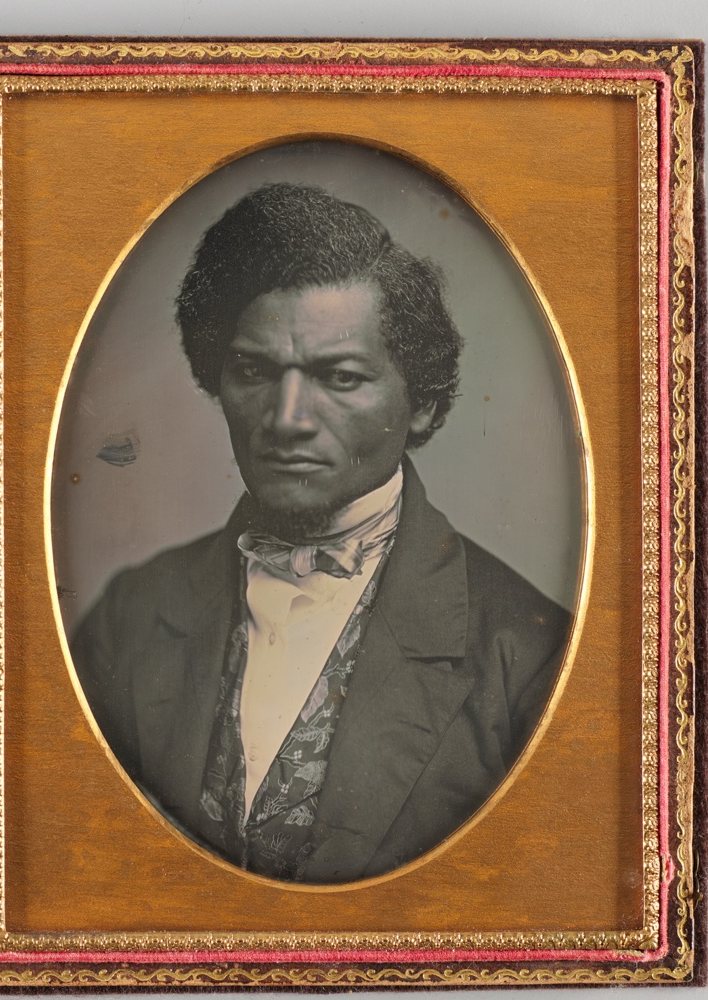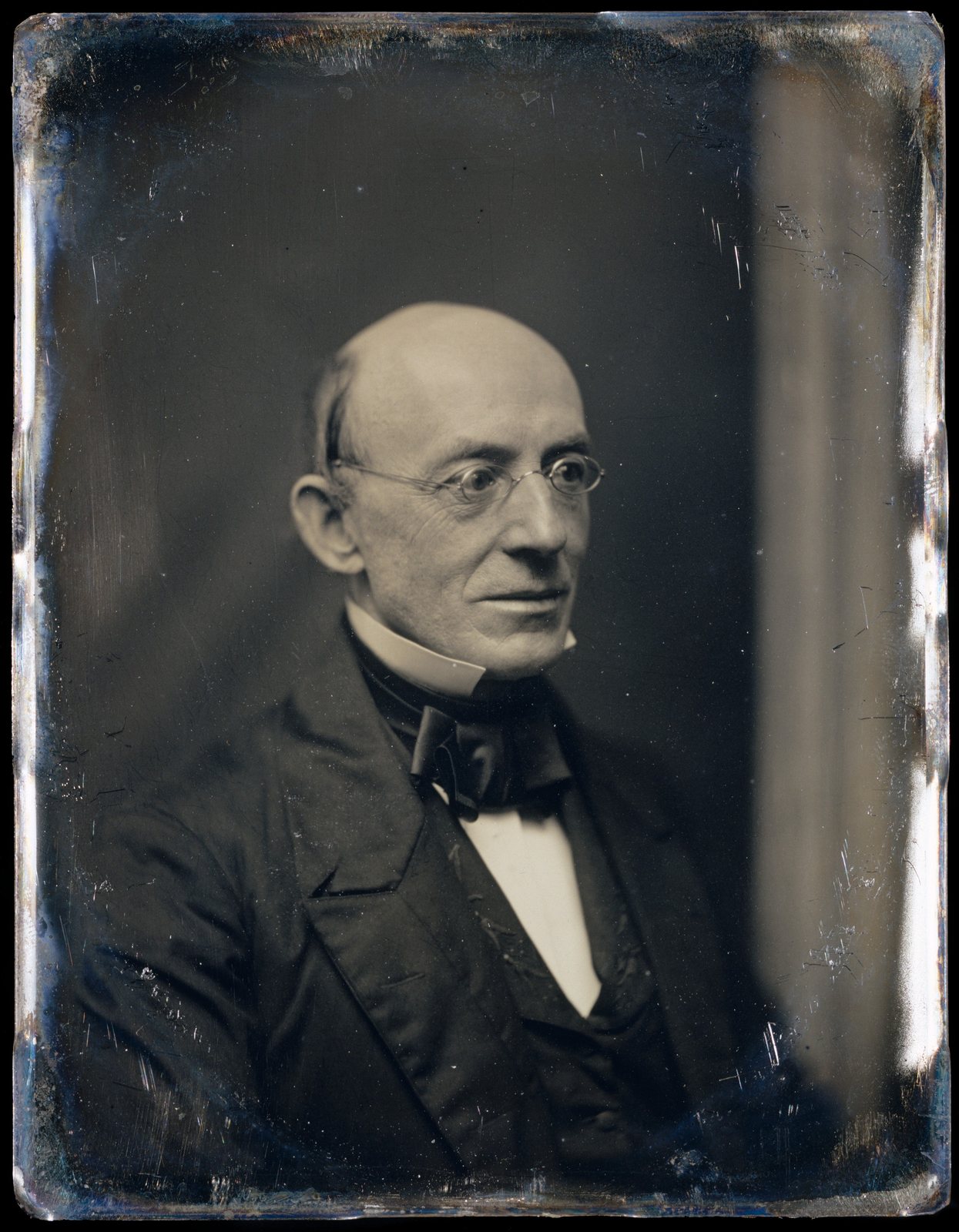
William Lloyd Garrison in middle age, in a daguerreotype portrait made around 1850.

William Lloyd Garrison

1805 – 1879

White abolitionist who published The Liberator from 1831 to 1865.

Draft for committee review

A printer’s apprentice

William Lloyd Garrison was born in December 1805 in Newburyport, Massachusetts. His father left the family in 1808, and the household fell into poverty. As a boy he sold homemade candy and delivered wood.

In 1818 he went to work at the Newburyport Herald and learned the printer’s trade. By 1826 he was editing the Newburyport Free Press, and in 1828 he became editor of the National Philanthropist in Boston. That year he met the Quaker abolitionist Benjamin Lundy, who drew him into the antislavery cause.

His first antislavery speech, at Boston’s Park Street Church on July 4, 1829, called for gradual emancipation and backed the American Colonization Society. He soon rejected both. He concluded that most colonizationists wanted to shrink the free Black population, and had no plan to end slavery. Later in 1829 he joined Lundy in Baltimore to edit The Genius of Universal Emancipation. A libel conviction there sent him to jail for seven weeks, until the merchant Arthur Tappan secured his release.

The Liberator

On January 1, 1831, Garrison and his partner Isaac Knapp published the first issue of The Liberator in Boston. The weekly demanded immediate, uncompensated emancipation and equal rights for Black Americans. In that first issue Garrison vowed to “strenuously contend for the immediate enfranchisement of our slave population.”

Black readers kept the paper alive. A committee of Black women led by Elizabeth Riley and Bathsheba Fowler raised money to launch it. Black readers made up about three quarters of its subscribers. The Black abolitionist William C. Nell later recalled that in its first year the paper “had not fifty white subscribers.”

The Liberator printed Black writers such as Maria Stewart. Its office also served as a clearinghouse for donations, clothing, news and jobs, and at times it sheltered people who had just escaped slavery. Garrison urged change through moral persuasion and rejected violence.

In 1832 Garrison helped found the New England Anti-Slavery Society. In December 1833 he helped found the American Anti-Slavery Society in Philadelphia, one of the first groups devoted to immediate emancipation.

I am in earnest—I will not equivocate—I will not excuse—I will not retreat a single inch—AND I WILL BE HEARD.

William Lloyd Garrison, “To the Public,” The Liberator, first issue, January 1, 1831

No union with slaveholders

Garrison’s views made him enemies. Southerners blamed The Liberator for Nat Turner’s rebellion and sent its editor death threats. On October 21, 1835, a Boston mob seized him and dragged him through the streets with a rope around his neck. The mayor helped get him to safety.

He urged abolitionists to stay out of party politics. He welcomed women as full workers in the movement, and he called the Constitution a proslavery document. In 1840 these positions split the American Anti-Slavery Society. He called the Constitution “a covenant with death” and “an agreement with hell.” On July 4, 1854, at Framingham, Massachusetts, he burned a copy in public.

His certainty also cost him allies. In 1851 Frederick Douglass concluded that the Constitution could be used against slavery. Garrison saw this as a betrayal and attacked him in print. In 1860 Douglass answered Garrison’s call for Northern secession: leaving the Union, he said, “would place the slave system more exclusively under the control of the slaveholding States.”

War and the last issue

Garrison at first distrusted Abraham Lincoln. Once the war began, he sided with the government, and he supported the Emancipation Proclamation.

In April 1865 he traveled to Charleston, South Carolina. On April 14, 1865, he watched the United States flag raised again over Fort Sumter. That night, in Washington, Lincoln was shot. In May he tried to disband the American Anti-Slavery Society, believing its work was done. Wendell Phillips and others disagreed, the members voted him down, and Garrison declined another term as president.

Garrison published the last issue of The Liberator on December 29, 1865, after the Thirteenth Amendment was ratified. He had published it every week for thirty-five years.

He went on working for the rights of Black Americans and of women. At a women’s suffrage meeting in 1873 he said, “I am still for immediate, unconditional, everlasting emancipation from oppression of everyone on the face of the earth.” He died in New York City on May 24, 1879, at the home of his daughter Fanny. The governor of Massachusetts declared a day of mourning. The Black abolitionist Lewis Hayden was among his pallbearers, and he was buried in Forest Hills Cemetery in Boston.
In the archive

Three portraits

  • William Lloyd Garrison in middle age, in a daguerreotype portrait made around 1850. (view at the source, opens in a new tab)
    ca. 1850In his mid-forties, nearly twenty years into The Liberator.Southworth and Hawes. The Metropolitan Museum of Art.
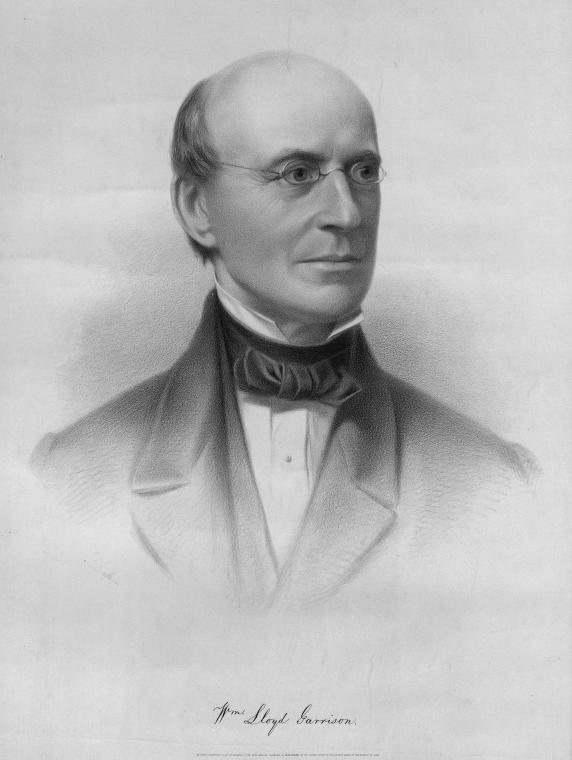
  • Lithograph portrait of William Lloyd Garrison, published in Boston in 1864. (view at the source, opens in a new tab)
    1864A lithograph portrait published in Boston during the last full year of the Civil War.J. H. Bufford, lithographer, after T. M. Johnston; published by Brainard & Co. Schomburg Center for Research in Black Culture, The New York Public Library.
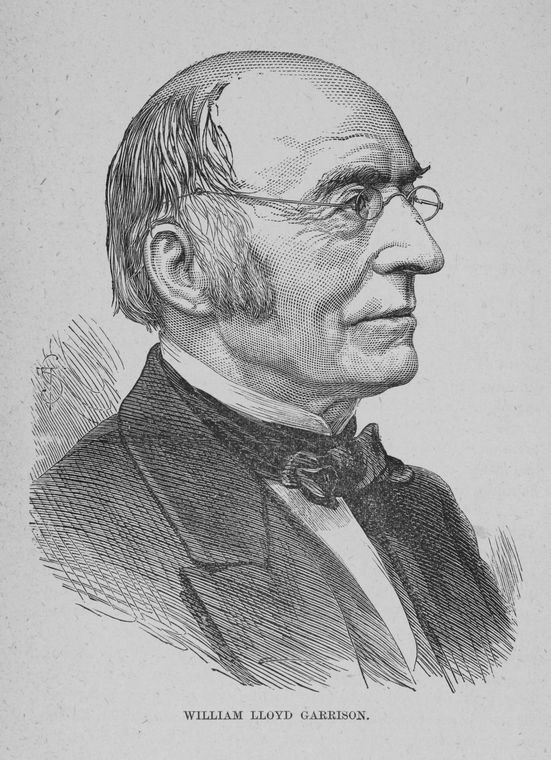
  • Engraved portrait of William Lloyd Garrison, printed as an illustration in an 1882 book. (view at the source, opens in a new tab)
    1882Printed in Frederick Douglass’s Life and Times, three years after Garrison’s death.Engraver not recorded. Schomburg Center for Research in Black Culture, The New York Public Library.

Key moments

William Lloyd Garrison’s life in time

  1. 1805

    Born in Newburyport, Massachusetts.

  2. 1818

    Begins work at the Newburyport Herald.

  3. 1829

    Gives his first antislavery speech in Boston, then joins Benjamin Lundy in Baltimore.

  4. 1831

    January 1: publishes the first issue of The Liberator.

  5. 1832

    Helps found the New England Anti-Slavery Society.

  6. 1833

    Helps found the American Anti-Slavery Society in Philadelphia.

  7. 1835

    October 21: a Boston mob drags him through the streets.

  8. 1840

    The American Anti-Slavery Society splits over women’s roles and politics.

  9. 1854

    July 4: burns a copy of the Constitution at Framingham.

  10. 1865

    April 14: sees the flag raised over Fort Sumter. December 29: publishes the last Liberator.

  11. 1879

    Dies on May 24 in New York City.

June 19, 1865

Connection to Juneteenth

On June 19, 1865, Union troops at Galveston, Texas, announced General Order No. 3, which told the people of Texas that all enslaved people were free. Freedom had been proclaimed two and a half years earlier. In Texas, it arrived with the Union Army. Garrison had no direct part in the events at Galveston. But 1865 was the year his life’s demand came true, and the year he and his allies argued over what that victory meant.

He had demanded immediate emancipation since 1831, when few white Americans would listen, and Black readers had kept his paper alive from its first year. For more than three decades the word “immediate” set him apart. Juneteenth remembers what delay cost: two and a half years between proclamation and freedom for the people enslaved in Texas.

In April 1865 he went to Charleston, where the war had begun at Fort Sumter. Thousands of freedpeople met him outside the Citadel and carried him on their shoulders around the square, then went on with him to Zion Church, where the crowd pressed into every available space. It was a jubilee of the kind that freedpeople in Galveston would begin to hold every June 19 from 1866 on.

In New York that May, at the annual meeting of the American Anti-Slavery Society, Garrison argued that its work was done and proposed to disband it. Wendell Phillips and others disagreed, and the members voted to continue. At that meeting Frederick Douglass warned that Southern legislatures could still find ways to strip freedpeople of their rights: “Slavery is not abolished until the black man has the ballot.” The question they argued over in May 1865, whether freedom declared is freedom secured, is the question at the heart of Juneteenth.

Garrison himself did not pretend the work was finished. He closed The Liberator on December 29, 1865, after the Thirteenth Amendment had been ratified. In his valedictory he wrote that “the extermination of chattel slavery” had been “gloriously consummated,” yet he saw “many cruel wrongs done to the freedmen which are yet to be redressed,” and he would not turn away “under the delusion that no more remains to be done.” He went on working for the rights of Black Americans and of women until his death in 1879. His last issue holds both halves of the Juneteenth story: the joy of freedom won, and the knowledge of all that remained.

Sources

Where this story comes from

Every fact on this page is drawn from the sources listed here. Quotations are given as they were first recorded.

  1. William Lloyd Garrison (opens in a new tab)National Park Service
  2. “The Liberator” (opens in a new tab)National Park Service
  3. William Lloyd Garrison Papers, 1833–1882 (collection guide and biographical sketch) (opens in a new tab)Massachusetts Historical Society
  4. The Liberator (first edition of last issue), December 29, 1865 (opens in a new tab)Massachusetts Historical Society
  5. The Liberator (opens in a new tab)Boston Public Library
  6. The Agitator, by James Williford, Humanities 34, no. 1 (2013) (opens in a new tab)National Endowment for the Humanities
  7. William Lloyd Garrison (Africans in America) (opens in a new tab)PBS / WGBH
  8. To the Public (The Liberator, January 1, 1831), from The Words of Garrison (1905) (opens in a new tab)Teaching American History, Ashland University
  9. The Constitution of the United States: Is It Pro-Slavery or Anti-Slavery?, by Frederick Douglass (March 26, 1860) (opens in a new tab)Teaching American History, Ashland University
  10. Valedictory: The Last Number of The Liberator (December 29, 1865), transcription (opens in a new tab)Fair Use Repository
  11. The Final Issue of The Liberator (Object of the Month, December 2015) (opens in a new tab)Massachusetts Historical Society
  12. The Abolitionists: Triumph (opens in a new tab)PBS, American Experience
  13. In What New Skin Will the Old Snake Come Forth? An Address Delivered in New York, May 10, 1865 (opens in a new tab)Frederick Douglass Papers Project
  14. Juneteenth: The Celebration of a New Freedom in America (opens in a new tab)National Archives, Rediscovering Black History
  15. The Fort Sumter “Storm Flag” (opens in a new tab)National Park Service
  16. William Lloyd Garrison, Southworth and Hawes (ca. 1850) (opens in a new tab)The Metropolitan Museum of Art
  17. Wm. Lloyd Garrison, lithograph by J. H. Bufford (1864) (opens in a new tab)The New York Public Library
  18. William Lloyd Garrison, from The Life and Times of Frederick Douglass (1882) (opens in a new tab)The New York Public Library

Portraits: Southworth and Hawes, ca. 1850; J, 1864; Engraver not recorded, 1882. Public domain in the United States.