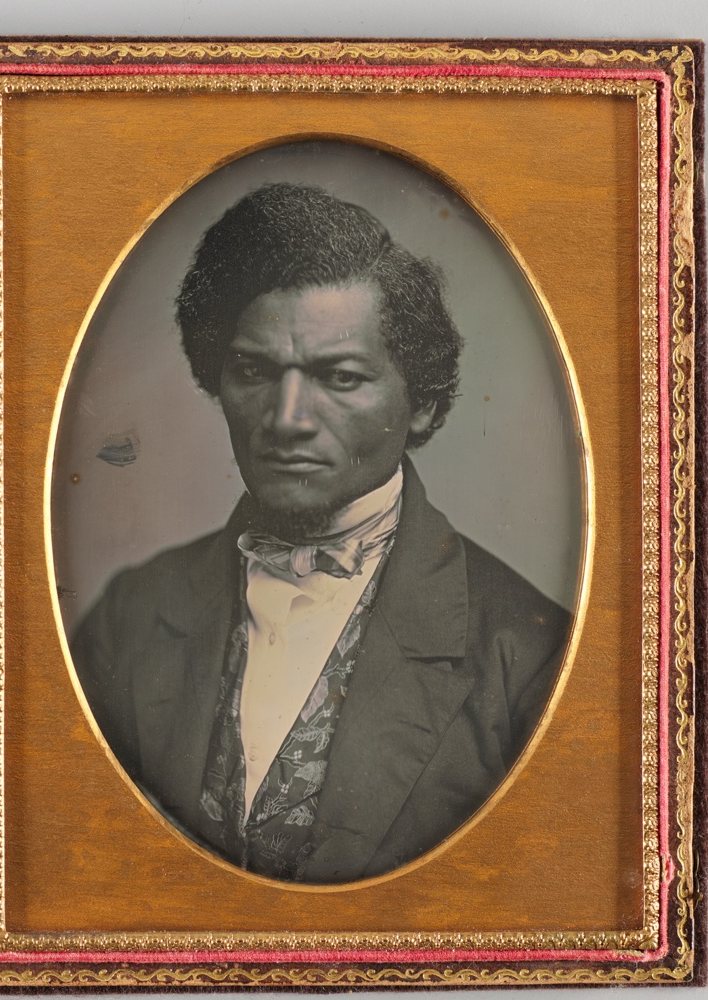
Frederick Douglass as a young man in a dark coat and white shirt, looking steadily at the camera.

Frederick Douglass

1818 – 1895

Freed himself from slavery and became the great orator, writer and editor of the abolition movement.

Draft for committee review

Born Frederick Bailey

Frederick Douglass was born Frederick Augustus Washington Bailey in February 1818, in Talbot County on Maryland’s Eastern Shore. His mother, Harriet Bailey, was enslaved. His father was a white man, rumored to be his enslaver, Aaron Anthony. His grandmother, Betsey Bailey, raised him, and he saw his mother only a few times before her death.

In 1826 he was sent to Baltimore to live with Hugh and Sophia Auld. Sophia Auld began to teach him to read until her husband stopped the lessons. The boy kept learning in secret. “From that moment,” he later wrote, “I understood the pathway from slavery to freedom.” In 1831 he bought The Columbian Orator, a book of speeches, to sharpen his reading and his speaking.

In 1834 he was hired out to Edward Covey, a farmer known for breaking enslaved workers. After repeated beatings, Douglass fought back, and Covey never beat him again. Douglass called the fight “the turning-point in my career as a slave.” The next year, hired out to William Freeland, he ran a secret Sunday school and taught other enslaved people to read. In 1836 a plan to escape was discovered. He was jailed, then sent back to Baltimore, where he learned to caulk ships.

Freedom and a voice

On September 3, 1838, Douglass escaped from Baltimore with papers borrowed from a free Black sailor and reached New York. Twelve days later he married Anna Murray, a free Black woman he had met in Baltimore. The couple settled in New Bedford, Massachusetts. Their host, Nathan Johnson, suggested the surname Douglass, from Sir Walter Scott’s poem The Lady of the Lake.

On August 11, 1841, at an antislavery convention on Nantucket, he rose to speak. The Massachusetts Anti-Slavery Society soon hired him as a lecturer. In 1843 a mob attacked him at an antislavery meeting in Pendleton, Indiana, and broke his right hand. It never fully healed.

In 1845 he published Narrative of the Life of Frederick Douglass, an American Slave. The book named the people who had enslaved him, and it exposed him to recapture. He left for a long lecture tour of Britain and Ireland. While he was abroad, British friends raised $711.66 and paid Hugh Auld for his freedom.

You have seen how a man was made a slave; you shall see how a slave was made a man.

Frederick Douglass, Narrative of the Life of Frederick Douglass, an American Slave (1845), chapter X

Editor and agitator

Douglass came home in 1847 a legally free man and settled in Rochester, New York. With money from British and Irish supporters, he bought a printing press and founded the North Star, an antislavery weekly. In 1848 he attended the first women’s rights convention, at Seneca Falls. In Rochester he also sheltered people escaping slavery.

In 1851 he declared that the Constitution was an antislavery document. The stand split him from William Lloyd Garrison, his early ally. On July 5, 1852, he gave a Fourth of July address at Corinthian Hall in Rochester, and in 1855 he published a second autobiography, My Bondage and My Freedom.

After John Brown’s raid on Harpers Ferry in 1859, authorities found a letter from Douglass to Brown. Douglass fled to Canada and then to England to avoid arrest.

War and public service

Douglass believed that Black Americans would win freedom and citizenship by fighting in the war. After the Emancipation Proclamation took effect on January 1, 1863, he recruited soldiers for the 54th Massachusetts Infantry. His sons Lewis and Charles enlisted, and Lewis was seriously wounded at Fort Wagner.

On August 10, 1863, Douglass met President Lincoln at the White House to protest the unequal pay and treatment of Black soldiers. In August 1864 Lincoln called him back and asked him to plan help for enslaved people escaping the Confederacy. In March 1865 Douglass attended Lincoln’s second inauguration. At the White House reception that day, Lincoln greeted him as “my friend Douglass” and asked what he thought of the address. Douglass called it “a sacred effort.”

In 1872 Douglass moved to Washington, D.C. In 1874 he became president of the troubled Freedman’s Savings and Trust Company, which soon failed. President Hayes named him U.S. marshal for the District in 1877, and President Garfield made him recorder of deeds in 1881. From 1889 to 1891 he served as U.S. minister resident and consul general to Haiti.

From 1878 his home was Cedar Hill, an estate in Anacostia. On February 20, 1895, he attended a meeting of the National Council of Women in Washington. That evening he died suddenly at Cedar Hill. He is buried in Mount Hope Cemetery in Rochester.
In the archive

Three portraits

  • Frederick Douglass as a young man in a dark coat and white shirt, looking steadily at the camera. (view at the source, opens in a new tab)
    1847–1852In his early thirties, in the years he founded the North Star.Samuel J. Miller. Art Institute of Chicago.
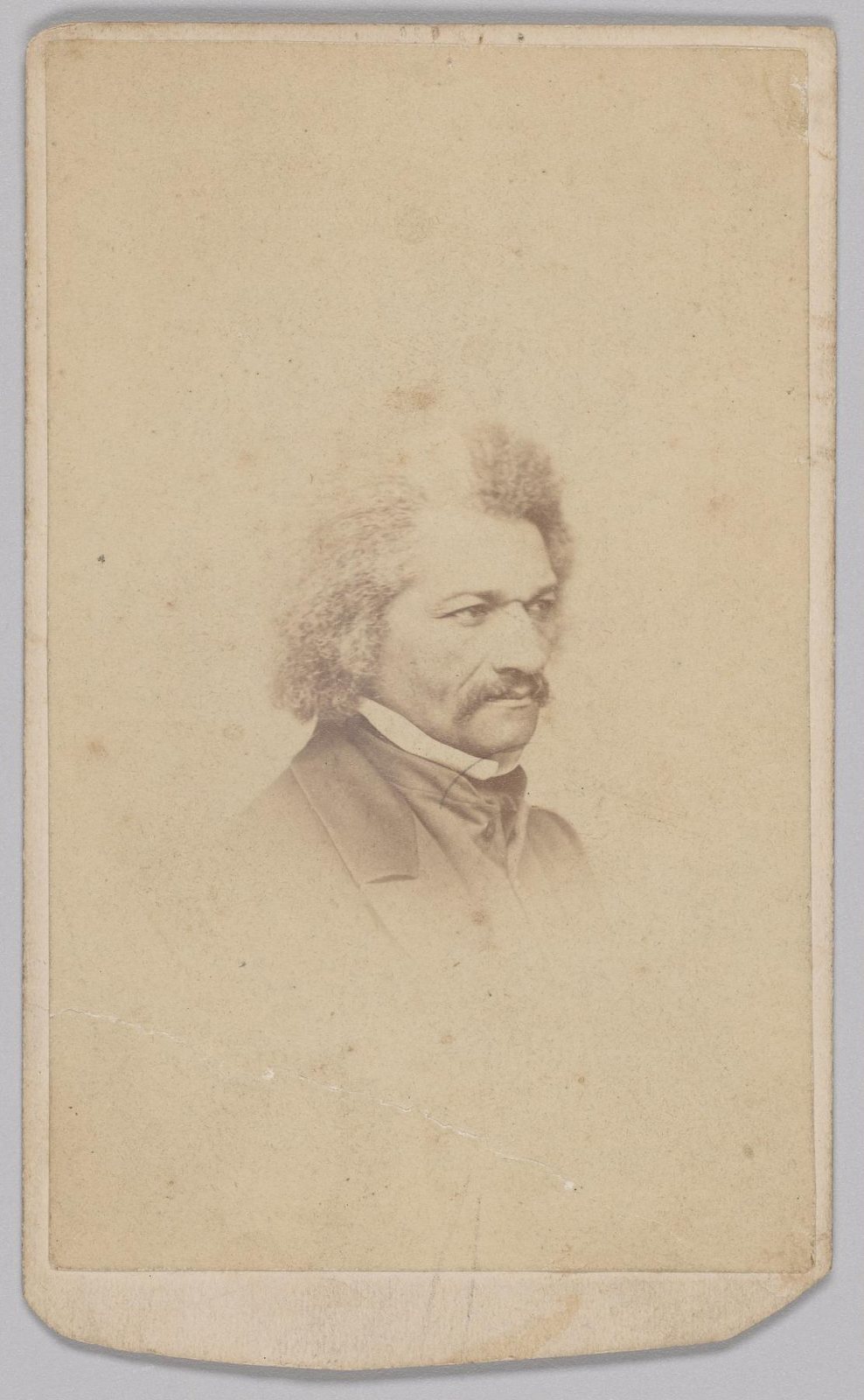
  • Frederick Douglass from the shoulders up, turned toward the viewer’s right, in a light collar, dark coat and dark cravat, with a mustache and a light streak in his hair. (view at the source, opens in a new tab)
    1862–1870In middle age, in the years of the Civil War and Reconstruction.Unidentified photographer. Smithsonian National Museum of African American History and Culture, gift of Carole A. Hyman.
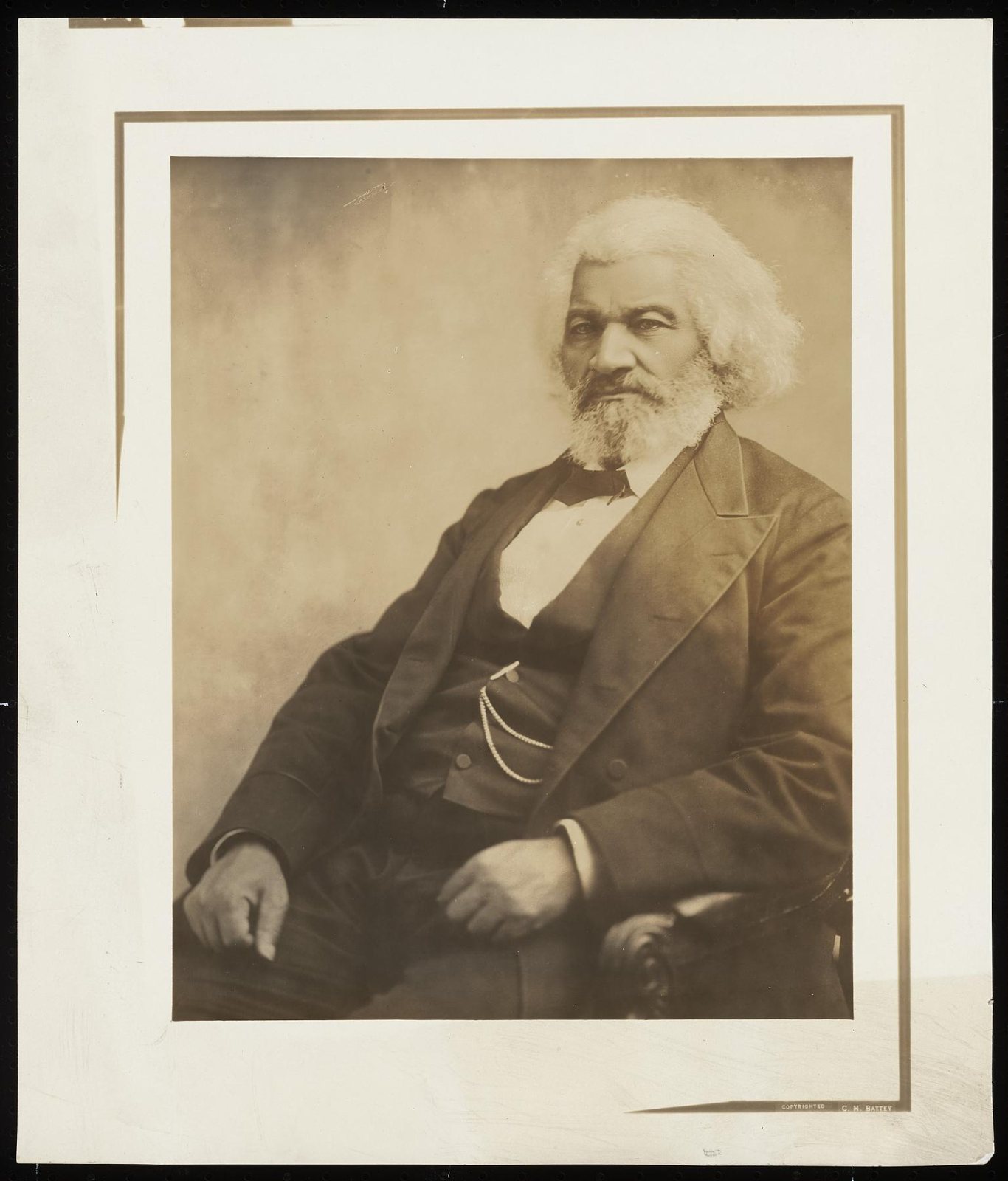
  • An older Frederick Douglass, seated, in a suit with jacket, vest and bow tie. (view at the source, opens in a new tab)
    c. 1895In the last years of his life. The museum dates this print to about 1895; Douglass died that February.C. M. Battey. Smithsonian National Museum of African American History and Culture.

Key moments

Frederick Douglass’s life in time

  1. 1818

    Born in February in Talbot County, Maryland.

  2. 1826

    Sent to Baltimore, where Sophia Auld begins to teach him to read.

  3. 1834

    Fights back against Edward Covey, who never beats him again.

  4. 1838

    September 3: escapes to New York. September 15: marries Anna Murray.

  5. 1841

    August 11: speaks at an antislavery convention on Nantucket.

  6. 1845

    Publishes his Narrative and leaves for Britain and Ireland.

  7. 1847

    Returns a free man and founds the North Star in Rochester.

  8. 1848

    Attends the first women’s rights convention, at Seneca Falls.

  9. 1863

    Recruits for the 54th Massachusetts. August 10: meets President Lincoln.

  10. 1877

    Appointed U.S. marshal for the District of Columbia.

  11. 1889

    Appointed U.S. minister resident and consul general to Haiti.

  12. 1895

    Dies on February 20 at Cedar Hill, Washington, D.C.

June 19, 1865

Connection to Juneteenth

On June 19, 1865, Union troops at Galveston, Texas, announced General Order No. 3, which told the people of Texas that all enslaved people were free. Freedom had been proclaimed two and a half years earlier. In Texas it took the arrival of the Union Army to make it real. Frederick Douglass played no part in the events at Galveston. Yet few Americans did more to define what that day would have to mean if freedom were to be more than a word.

Long before Juneteenth, abolitionists held “First of August” celebrations each year to mark the emancipation of enslaved people in the British West Indies in 1834, and Douglass was one of their great voices. At one such celebration in Canandaigua, New York, on August 3, 1857, he told the crowd, “If there is no struggle there is no progress,” and, “Power concedes nothing without a demand. It never did and it never will.” Five years earlier, in Rochester, he had asked, “What, to the American slave, is your 4th of July?” Juneteenth belongs to that long tradition of emancipation days, and in 2021 Congress named it Juneteenth National Independence Day.

During the war he argued that Black men must fight for their own freedom, and once the Emancipation Proclamation took effect he recruited them, his own sons among them. By the war’s end about 179,000 Black men had served in the Union Army, the army that carried the proclamation deep into the former Confederacy, as far as Galveston, and enforced it where it stood.

He knew that announcing freedom would not finish the work. On May 10, 1865, forty days before Galveston, he urged the American Anti-Slavery Society in New York not to disband, warning that Southern legislatures could still find ways to strip freedpeople of their rights. “Slavery is not abolished until the black man has the ballot,” he said. The citizenship and voting amendments that followed answered that demand on paper; the decades after showed how hard it was to hold.

In April 1888, at Washington’s annual celebration of emancipation in the District of Columbia, Douglass spoke of the freedman of the South: “I here and now denounce his so-called emancipation as a stupendous fraud.” He spoke at a festival of freedom and refused to let it become only a festival. Juneteenth carries both of his truths: freedom is worth celebrating, and freedom must be defended and completed.

Sources

Where this story comes from

Every fact on this page is drawn from the sources listed here. Quotations are given as they were first recorded.

  1. Frederick Douglass Timeline (opens in a new tab)Library of Congress, Frederick Douglass Papers
  2. Lincoln and Frederick Douglass (opens in a new tab)Library of Congress, With Malice Toward None exhibition
  3. Confronting a President: Douglass and Lincoln (opens in a new tab)National Park Service, Frederick Douglass National Historic Site
  4. District of Columbia: Frederick Douglass National Historic Site (opens in a new tab)National Park Service
  5. Frederick Douglass (1818–1895), MSA SC 3520-13800 (opens in a new tab)Maryland State Archives
  6. Timeline of Douglass’s Life (opens in a new tab)Frederick Douglass Papers Project
  7. What, to the American Slave, Is Your 4th of July? (opens in a new tab)Library of Congress, Headlines & Heroes blog
  8. Black Soldiers in the Civil War (opens in a new tab)National Archives, DocsTeach
  9. Narrative of the Life of Frederick Douglass, an American Slave (1845) (opens in a new tab)Project Gutenberg
  10. Juneteenth: General Order No. 3 (opens in a new tab)National Archives
  11. The Significance of Emancipation in the West Indies: An Address Delivered in Canandaigua, New York, on August 3, 1857 (opens in a new tab)Frederick Douglass Papers Project
  12. In What New Skin Will the Old Snake Come Forth? An Address Delivered in New York, May 10, 1865 (opens in a new tab)Frederick Douglass Papers Project
  13. I Denounce the So-Called Emancipation as a Stupendous Fraud (April 16, 1888, from the Washington National Republican, April 17, 1888) (opens in a new tab)Frederick Douglass: A Selection of Works, CUNY
  14. Frederick Douglass on the Disfranchisement of Blacks in the South (opens in a new tab)Gilder Lehrman Institute of American History
  15. Juneteenth National Independence Day Act, Public Law 117-17 (June 17, 2021) (opens in a new tab)Congress.gov
  16. Frederick Douglass, daguerreotype by Samuel J. Miller (1847–1852) (opens in a new tab)Art Institute of Chicago
  17. Carte-de-visite of Frederick Douglass (1862–1870) (opens in a new tab)Smithsonian National Museum of African American History and Culture
  18. Frederick Douglass, by C. M. Battey (c. 1895) (opens in a new tab)Smithsonian National Museum of African American History and Culture

Portraits: Samuel J, 1847–1852; Unidentified photographer, 1862–1870; C, c. 1895. Public domain in the United States.