Named for a ship
Phillis Wheatley was born in West Africa around 1753 and was enslaved as a child. On July 11, 1761, she arrived in Boston aboard a slave ship called the Phillis.
Almost nothing is known of her life before Boston. Her birth name is lost. Historians have suggested that she came from the region of present-day Senegal and the Gambia, but the record is thin.
John Wheatley, a Boston merchant and tailor, bought her for his wife, Susanna. They named her after the ship that had carried her. John Wheatley later wrote that she was about seven or eight years old when she came.
The Wheatleys taught her to read and write, and she grew up in the household’s Congregationalist church circles. By John Wheatley’s account she learned English in sixteen months. She went on to study history, British literature, Greek and Latin.
A young poet in Boston
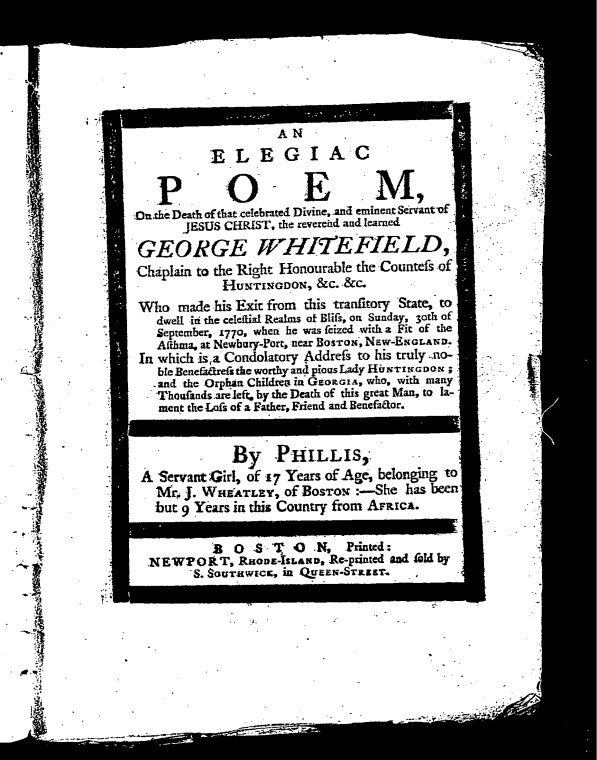
Her first published poem appeared in the Newport Mercury, a Rhode Island newspaper, in December 1767. She was about fourteen. In 1770 she wrote an elegy on the death of George Whitefield, a famous English preacher. It was printed in Boston and Newport, and it made her name.
She then sought subscribers in Boston for a book of her poems, but too few signed. Some readers doubted that an enslaved African girl could write such verse. In 1772 she defended her work before a panel of prominent Boston men. On October 28, eighteen of them, among them Governor Thomas Hutchinson and John Hancock, signed a statement that they believed the poems were hers.
That statement, with a letter from John Wheatley describing her education, later opened her book. Her publishers included them to answer readers who doubted her.
…in every human Breast, God has implanted a Principle, which we call Love of Freedom; it is impatient of Oppression, and pants for Deliverance…
London, 1773
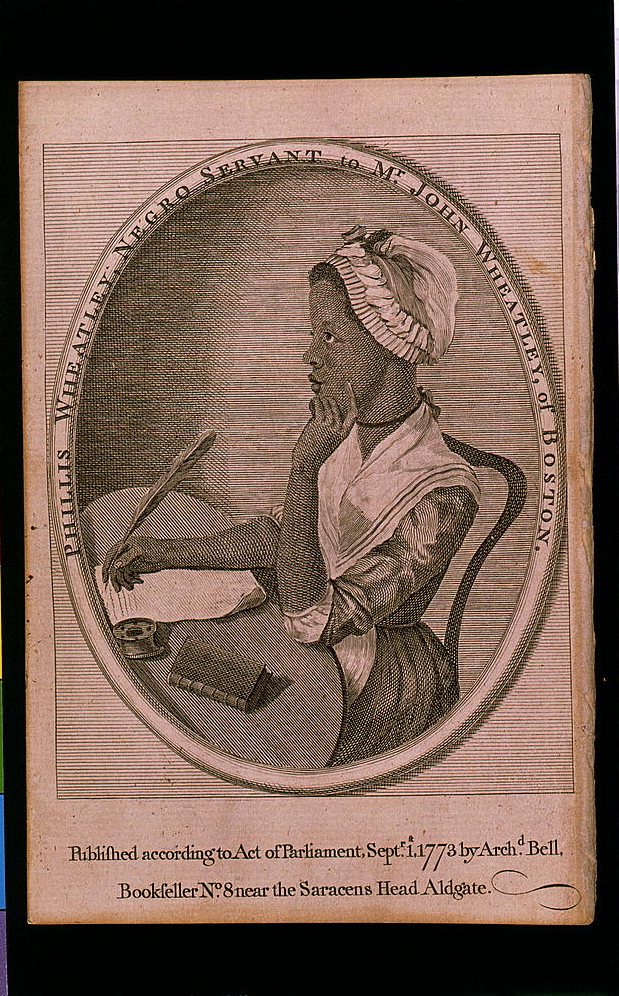
In May 1773 Wheatley sailed for London to see her book into print. There she met the antislavery campaigner Granville Sharp and Benjamin Franklin. Poems on Various Subjects, Religious and Moral was printed in London that September. Its frontispiece showed her at her writing desk, pen in hand. One poem in it, “On Being Brought from Africa to America,” looked back on her own passage. It begins, “’Twas mercy brought me from my Pagan land.”
She was back in Boston by mid-September. Soon afterward the Wheatleys freed her. In an October 1773 letter to David Wooster, she reported that she had been given her freedom. Her books came over aboard the Dartmouth, one of the ships caught up in the Boston Tea Party that December. Copies went on sale in Boston at the end of January 1774.
In February 1774 she wrote to the Reverend Samson Occom. She argued that God had planted a love of freedom in every human breast, and that the same principle lived in enslaved Africans. She called the enslavers “our modern Egyptians.” New England newspapers printed the letter that spring.
Free, and poor
In October 1775, early in the Revolutionary War, Wheatley sent a poem and a letter to General George Washington. Her letter reached him in mid-December, amid the siege of Boston. He replied on February 28, 1776, and apologized for the delay. He praised her verses and invited her to visit him at Cambridge. He wrote that he had thought of publishing the poem but held back for fear of seeming vain. Joseph Reed, to whom Washington sent it, saw it into print. It appeared in the Virginia Gazette on March 30, 1776, and Thomas Paine reprinted it in April.
In 1778 she married John Peters, a free Black grocer. By the next year both Susanna and John Wheatley had died. On October 30, 1779, she advertised in the Boston Evening Post for subscribers to a second volume of poems. Without patrons to support it, the book never appeared.
The couple fell into poverty. Their children died in infancy. In 1784 John Peters was jailed for debt, and she worked as a maid. That year she published one of her last poems, “Liberty and Peace.” Phillis Wheatley Peters died in Boston on December 5, 1784, at about thirty-one.