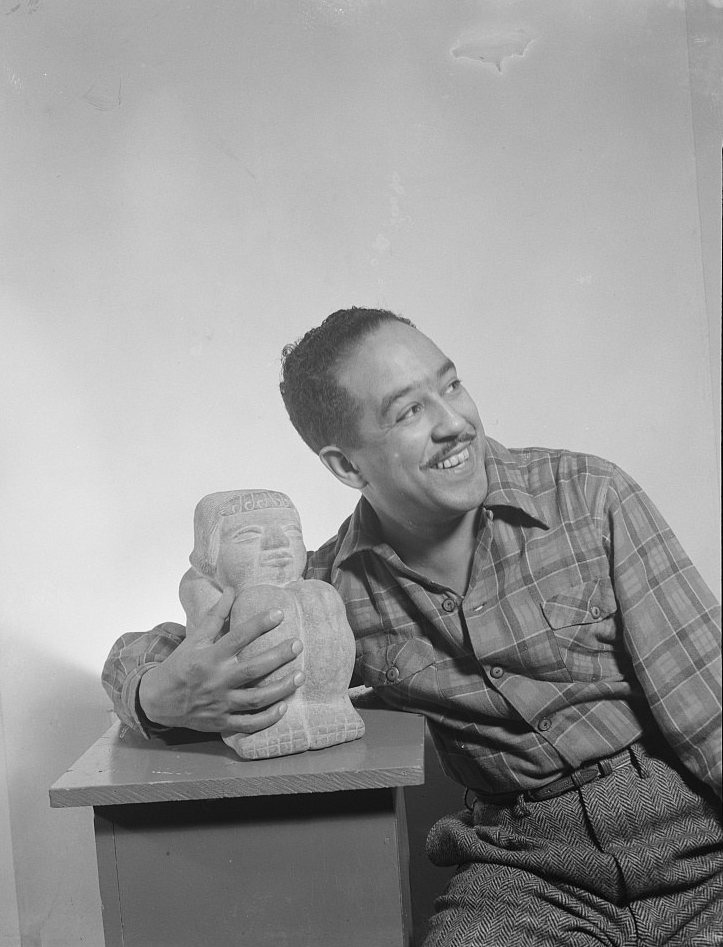
Black-and-white photograph of Langston Hughes, smiling, in a plaid shirt, seated with one arm around a small carved stone figure on a pedestal and looking off to the right.

Langston Hughes

1901 – 1967

The poet of the Harlem Renaissance.

Draft for committee review

A Kansas childhood

Langston Hughes was born in Joplin, Missouri, on February 1, 1901. For most of the twentieth century the year was given as 1902, until research in 2018 showed that he was born a year earlier. His parents, James and Carrie Hughes, separated soon after his birth, and his father later settled in Mexico.

While his mother moved from city to city looking for work, the boy grew up largely in Lawrence, Kansas, with his grandmother, Mary Langston. Her first husband, Lewis Sheridan Leary, had been killed in John Brown’s raid on Harpers Ferry in 1859. Her second husband, Hughes’s grandfather Charles Langston, was an abolitionist.

Kansas had its own color line. In 1909, when he entered the second grade at Pinckney School in Lawrence, he was taught with the other African American children in a separate room. His grandmother died in March 1915, and that year he left Lawrence to join his mother in Illinois. The family later settled in Cleveland, Ohio, where he was class poet and yearbook editor at Central High School.

Rivers and the open sea

The summer after he finished high school, Hughes wrote “The Negro Speaks of Rivers,” a short poem that sets the history of Black people beside the oldest rivers of the world. The Crisis, the NAACP magazine edited by W. E. B. Du Bois, published it in June 1921.

That fall he entered Columbia University in New York. He left after a year, but he had found Harlem, which became his home and his great subject. He signed on as a crewman aboard a freighter, the SS Malone, which carried him to Africa, and then lived for a time in Paris, where he worked as a doorman.

In 1925 he was in Washington, D.C., working as a busboy at the Wardman Park Hotel and as a research assistant to the historian Carter G. Woodson. When the poet Vachel Lindsay came to the hotel, Hughes left three poems beside his plate. Lindsay read them at his table, and the next morning newspapers reported that he had “discovered” a busboy poet. In fact the publisher Alfred A. Knopf had already accepted Hughes’s first book.

We younger Negro artists who create now intend to express our individual dark-skinned selves without fear or shame.

Langston Hughes, “The Negro Artist and the Racial Mountain,” The Nation, June 23, 1926

A voice of the Harlem Renaissance

The Weary Blues appeared in 1926, with an introduction by Carl Van Vechten. Its poems drew on the blues and jazz. That year Hughes also entered Lincoln University in Pennsylvania, which awarded his degree in 1929.

On June 23, 1926, The Nation published his essay “The Negro Artist and the Racial Mountain.” In it he urged Black artists to draw on the lives and music of ordinary Black people, and to keep working whether white or Black audiences approved or not.

His first novel, Not Without Laughter (1930), won the Harmon Foundation’s gold medal for literature. His play Mulatto opened on Broadway in 1935. He travelled to the Soviet Union, Haiti and Japan, reported on the Spanish Civil War in 1937, and in 1940 published his autobiography, The Big Sea.

Writing for the long fight

From 1942 to 1962 Hughes wrote a weekly column for the Chicago Defender. He wrote about Jim Crow, white supremacy and segregation in the armed forces. In his columns he created a comic character, Jesse B. Semple, called Simple, who went on to carry a series of books, from Simple Speaks His Mind (1950) to Simple’s Uncle Sam (1965).

In March 1953 he was called before Senator Joseph McCarthy’s Permanent Subcommittee on Investigations, which was examining books in the State Department’s libraries overseas. Hughes denied under oath that he had ever been a member of the Communist Party. He said that he had once favored a Soviet form of government in the United States, and that his views had changed from about the early 1940s. He did not identify anyone he knew as a Communist.

He wrote the lyrics for Kurt Weill’s opera Street Scene (1947), edited anthologies of Black writing and folklore, and in 1962 published Fight for Freedom: The Story of the NAACP. In 1960 the NAACP awarded him its Spingarn Medal.

From 1947 he lived at 20 East 127th Street in Harlem, in the home of Emerson and Ethel “Toy” Harper, whom he regarded as an adopted uncle and aunt. He wrote in a workroom on the top floor. He died in New York on May 22, 1967, of complications of prostate cancer. Part of his ashes lies beneath “Rivers,” a terrazzo floor by the artist Houston Conwill at the Schomburg Center for Research in Black Culture, inscribed with “The Negro Speaks of Rivers.”
In the archive

Portraits

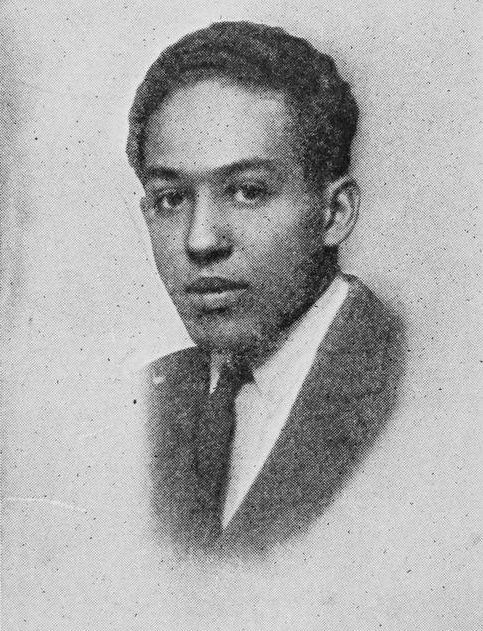
  • Halftone portrait of a young Langston Hughes in a dark jacket, white shirt and tie, looking toward the viewer, with his name printed in small capitals beneath the photograph. (view at the source, opens in a new tab)
    Published 1923A young Langston Hughes, as pictured in Robert T. Kerlin's 1923 anthology Negro Poets and Their Poems.Photographer unknown; from Robert Thomas Kerlin, Negro Poets and Their Poems (Washington, D.C.: Associated Publishers, 1923). Schomburg Center for Research in Black Culture, Jean Blackwell Hutson Research and Reference Division, The New York Public Library.
  • Black-and-white photograph of Langston Hughes, smiling, in a plaid shirt, seated with one arm around a small carved stone figure on a pedestal and looking off to the right. (view at the source, opens in a new tab)
    1943Langston Hughes photographed by Gordon Parks for the Office of War Information.Gordon Parks, photographer, U.S. Office of War Information. Library of Congress Prints and Photographs Division, FSA/OWI Collection (LC-DIG-fsa-8d39489).

Key moments

Langston Hughes’s life in time

  1. 1901

    Born February 1 in Joplin, Missouri.

  2. 1915

    His grandmother dies; he leaves Lawrence, Kansas, to join his mother.

  3. 1921

    The Crisis publishes “The Negro Speaks of Rivers” in June. Enters Columbia University.

  4. 1925

    As a busboy in Washington, D.C., leaves three poems beside Vachel Lindsay’s plate.

  5. 1926

    Publishes The Weary Blues. June 23: The Nation prints “The Negro Artist and the Racial Mountain.”

  6. 1929

    Graduates from Lincoln University in Pennsylvania.

  7. 1930

    Publishes his first novel, Not Without Laughter.

  8. 1940

    Publishes his autobiography, The Big Sea.

  9. 1942

    Begins twenty years as a weekly columnist for the Chicago Defender.

  10. 1953

    Testifies before Senator McCarthy’s Permanent Subcommittee on Investigations.

  11. 1960

    Receives the NAACP’s Spingarn Medal.

  12. 1967

    Dies May 22 in New York City.

June 19, 1865

Connection to Juneteenth

Langston Hughes was born in 1901, thirty-six years after Union troops at Galveston announced that the enslaved people of Texas were free, and he was raised on the story of how that freedom had been fought for. His grandmother, Mary Langston, had been the wife of Lewis Sheridan Leary, who was killed in John Brown’s raid on Harpers Ferry in 1859. Her second husband, Hughes’s grandfather Charles Langston, had been convicted under the Fugitive Slave Act for his part in the Oberlin-Wellington Rescue of 1858, when a crowd in Ohio freed John Price, a man seized by slave catchers. In her house in Lawrence, Kansas, she told the boy what he later remembered as “long, beautiful stories about people who wanted to make the Negroes free.”

She kept a shawl that, family tradition held, Leary had worn when he left Oberlin to join Brown, and she covered her grandson with it as he slept. Historians now doubt that the shawl ever reached Harpers Ferry, but the memory it carried was real, and Hughes kept it: in 1943 he gave the shawl to the Ohio Historical Society. A story told by an elder, an heirloom passed down, a past handed to a child so that it will not be lost – that is how Juneteenth itself has lived from one generation to the next.

His family’s fight did not end with emancipation. His grandfather’s brother, John Mercer Langston, joined the Freedmen’s Bureau in 1867 as its general inspector of schools, became dean of the law school at Howard University in 1870, and in 1890 took his seat as the first African American to win a seat in Congress from Virginia. Education, citizenship, the vote: the Langstons worked at the very things that would make freedom more than a word.

Hughes had no part in the events of 1865, and he grew up under the color line that rose when Reconstruction ended. He made himself a keeper of the story. “The Negro Speaks of Rivers,” the poem that made his name, travels through the history of Black people by way of the world’s great rivers and comes at last to the Mississippi in the age of slavery and of Abraham Lincoln. Later he wrote and edited books that carried Black history and culture to a general audience, among them A Pictorial History of the Negro in America (1956, with Milton Meltzer), The Book of Negro Folklore (1958, with Arna Bontemps) and Fight for Freedom: The Story of the NAACP (1962). For twenty years his weekly newspaper column measured the America he lived in against the freedom it had promised. A portion of his ashes lies at the Schomburg Center for Research in Black Culture in Harlem, a library devoted to the history he spent his life telling.

Sources

Where this story comes from

Every fact on this page is drawn from the sources listed here. Quotations are given as they were first recorded.

  1. Langston Hughes (opens in a new tab)National Park Service
  2. Langston Hughes (opens in a new tab)Encyclopaedia Britannica
  3. Langston Hughes in Lawrence, Kansas (opens in a new tab)University of Kansas Libraries, Kenneth Spencer Research Library
  4. Langston Hughes, Experimental Folklorist (opens in a new tab)Library of Congress, Folklife Today blog
  5. The Negro Artist and the Racial Mountain (June 23, 1926) (opens in a new tab)The Nation
  6. Langston Hughes (opens in a new tab)Academy of American Poets, Poets.org
  7. Langston Hughes House, Designation Report (1981) (opens in a new tab)New York City Landmarks Preservation Commission
  8. Remembering Sculptor Houston Conwill (1947–2016) (opens in a new tab)The New York Public Library
  9. Spingarn Medal (opens in a new tab)Encyclopaedia Britannica
  10. Langston Hughes and the Chicago Defender: Essays on Race, Politics, and Culture, 1942–62 (opens in a new tab)University of Illinois Press
  11. Executive Sessions of the Senate Permanent Subcommittee on Investigations, 1953–54, Vol. 2 (testimony of Langston Hughes, March 24, 1953) (opens in a new tab)U.S. Senate
  12. Fight for Freedom: The Story of the NAACP (W. W. Norton, 1962), catalog record (opens in a new tab)Texas A&M University Libraries
  13. This Shawl Belonged to Langston Hughes (True) and Was Worn by One of John Brown’s Men at Harpers Ferry (Well . . .), by Steven Lubet and Rachel Maines (opens in a new tab)National Endowment for the Humanities, Humanities magazine (Summer 2016)
  14. The Big Sea (1940), Part I, “Negro” (opens in a new tab)Toronto Metropolitan University Pressbooks
  15. Oberlin-Wellington Rescue (opens in a new tab)Encyclopedia of Cleveland History, Case Western Reserve University
  16. John Mercer Langston (1829–1897) (opens in a new tab)Encyclopedia Virginia, Virginia Humanities
  17. The Poems (We Think) We Know: “The Negro Speaks of Rivers” by Langston Hughes (opens in a new tab)Los Angeles Review of Books
  18. A Pictorial History of the Negro in America, by Langston Hughes and Milton Meltzer (Crown, 1956), catalog record (opens in a new tab)Texas A&M University Libraries

Portraits: Photographer unknown; from Robert Thomas Kerlin, Negro Poets and Their Poems (Washington, D, Published 1923; Gordon Parks, photographer, U, 1943. Public domain in the United States.