New Orleans
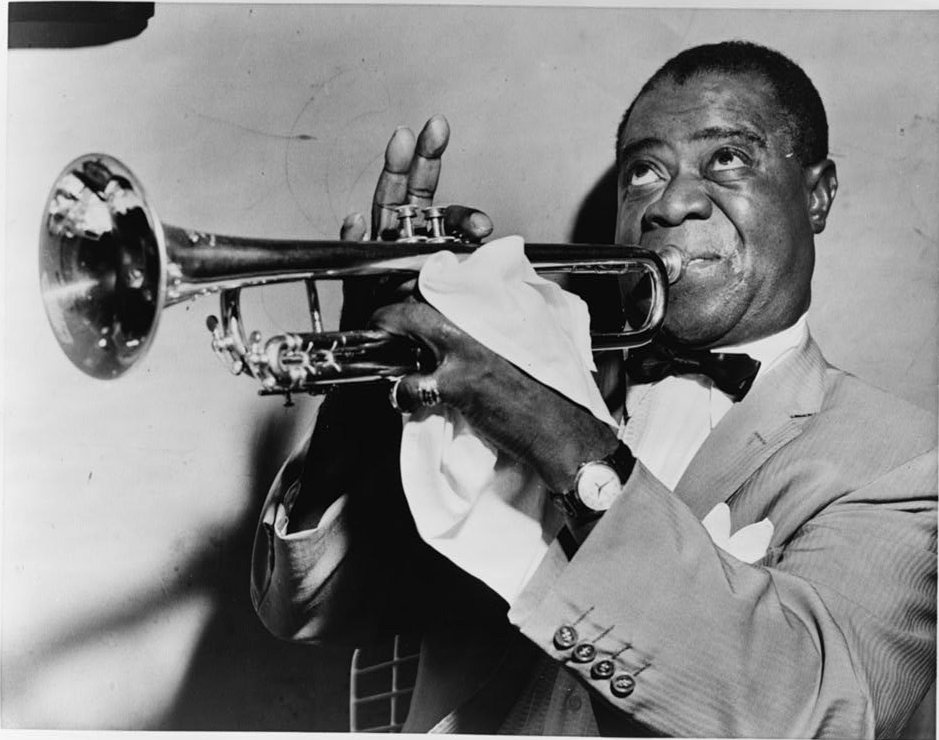
Louis Armstrong was born in New Orleans on August 4, 1901. For most of his life he gave his birthday as July 4, 1900, but records, among them his baptismal record, show the later date. His mother, Mayann, raised him in a poor neighborhood known as “the Battlefield.” He left school after the fifth grade to work.
As a boy he worked on the coal and junk wagons of the Karnofsky family, who kept a store nearby, and he often ate at their table. They loaned him the money for his first cornet. On New Year’s Eve 1912, near the Karnofsky store, he was arrested for firing a pistol and sent to the Colored Waif’s Home for Boys. There a teacher, Peter Davis, gave him lessons, and Armstrong became leader of the home’s brass band. He was released in 1914.
Up the river to Chicago
The leading cornetist in New Orleans, Joe “King” Oliver, became his mentor. Around 1918 Armstrong took Oliver’s place in Kid Ory’s band, and he played in dance bands on Mississippi riverboats. In 1922 Oliver sent for him to play second cornet in his Creole Jazz Band in Chicago, and the band began recording in 1923. In 1924 Armstrong married the band’s pianist, Lil Hardin, and spent about a year in New York with Fletcher Henderson’s orchestra.
Back in Chicago in 1925, he began recording under his own name with the Hot Five, and later the Hot Seven. The Louis Armstrong House Museum calls these records, made between 1925 and 1928, the most influential in jazz, and many scholars consider Armstrong the first great jazz soloist. His 1926 recording of Heebie Jeebies helped make scat singing popular, and West End Blues followed in 1928. Singers including Ella Fitzgerald, Billie Holiday and Bing Crosby took up his way of phrasing a song.
I’ll never back down from the things I said and the things I believe in.
A voice the world knew
In 1929 he moved to New York, and in 1932 and 1933 he performed in Europe. From 1935 Joe Glaser managed his career. Armstrong appeared in films through the 1930s and published a memoir, Swing That Music, in 1936. In 1943 he settled in Corona, Queens, with his fourth wife, Lucille Wilson. In 1947 he formed a small group, Louis Armstrong and His All Stars, which included white musicians such as the trombonist Jack Teagarden. It remained his band for the rest of his career. In 1949 he became the first jazz musician on the cover of Time.
He toured the world. In May 1956, on a trip arranged by the CBS broadcaster Edward R. Murrow, he played an open-air concert in Accra, in the Gold Coast, the British colony that became Ghana, before a crowd reported at more than 100,000. In 1959 he toured Europe and the Middle East, and in 1960 and 1961 he made a long tour of Africa sponsored by the State Department. He became known as “Ambassador Satch.” In 1964 his recording of Hello, Dolly! reached number one on the pop charts, displacing the Beatles.
Little Rock
In September 1957 Arkansas governor Orval Faubus used the National Guard to keep nine Black students out of Little Rock’s Central High School. On September 17, in his hotel room in Grand Forks, North Dakota, Armstrong spoke with Larry Lubenow, a young reporter for the Grand Forks Herald. As Lubenow reported it, Armstrong called President Eisenhower “two faced,” said he had “no guts,” and said that because of the way his people were being treated in the South, the government could go to hell. He also said he would not make a planned State Department tour of the Soviet Union.
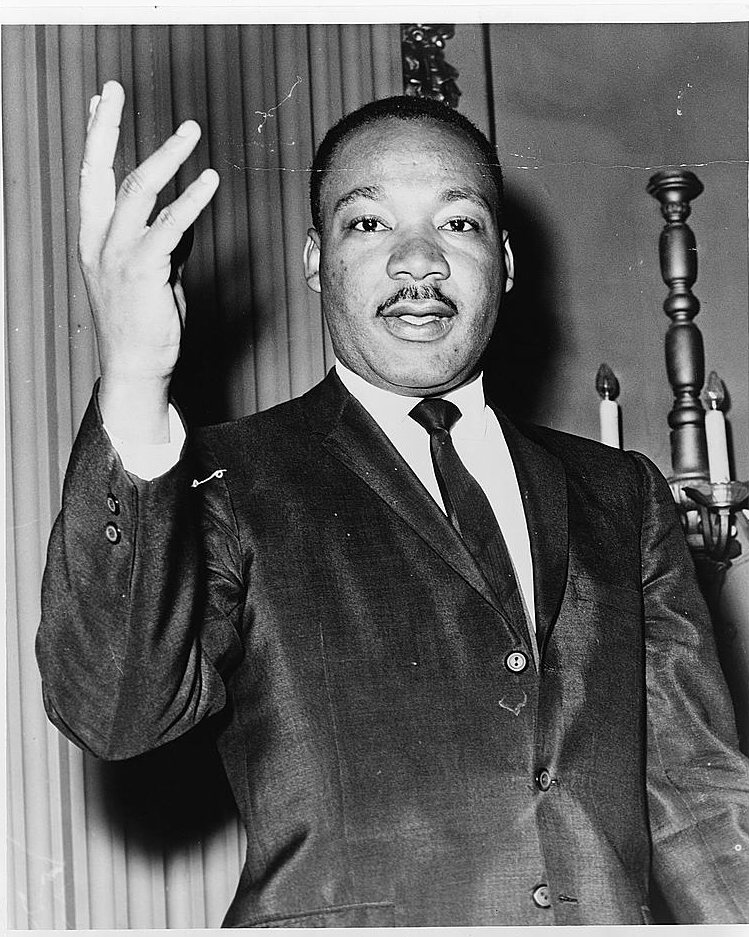
The story ran around the world. Armstrong stood by it. Days later Eisenhower sent the 101st Airborne Division to Little Rock, and Armstrong publicly congratulated the president on the decision. In those years some younger musicians and Black critics faulted his stage manner as too eager to please white audiences. Armstrong did not march, but he gave money to civil rights organizations, including support for Martin Luther King Jr.
Last years
Armstrong suffered his first heart attack in 1959 but kept performing. In 1967 he recorded What a Wonderful World. A few months after a final engagement at the Waldorf-Astoria in New York, he died in his sleep at home on July 6, 1971. His home in Queens became a National Historic Landmark in 1976 and is now the Louis Armstrong House Museum.