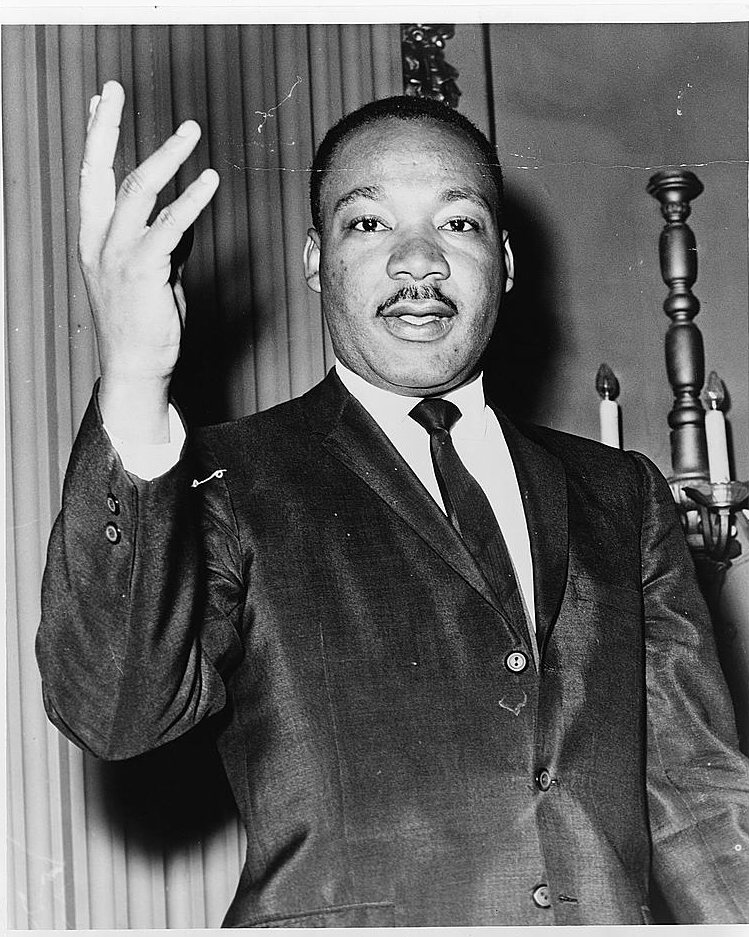
Black-and-white photograph of Martin Luther King Jr., half-length in a dark suit and tie, raising his right hand as he speaks, with a candle sconce on the wall behind him.

Martin Luther King Jr.

1929 – 1968

A leader of the Civil Rights Movement; Nobel Peace Prize, 1964.

Draft for committee review

A preacher’s son

Martin Luther King Jr. was born Michael King Jr. in Atlanta on January 15, 1929, to the Reverend Michael King and Alberta Williams King. In 1934 his father changed both their names to Martin Luther King.

King entered Morehouse College at fifteen. He was ordained in February 1948 and graduated that June with a degree in sociology. He then studied at Crozer Theological Seminary in Pennsylvania, where he graduated at the top of his class in 1951, and at Boston University, which awarded him a doctorate in 1955. On June 18, 1953, he married Coretta Scott near Marion, Alabama. In September 1954 he became pastor of Dexter Avenue Baptist Church in Montgomery.

Montgomery

On December 1, 1955, Rosa Parks was arrested on a Montgomery bus. Four days later, Black leaders formed the Montgomery Improvement Association to run a boycott of the buses, and they chose King, then 26, as president. On January 30, 1956, his house was bombed while he was at a mass meeting. His wife and baby daughter were unhurt, and King urged the angry crowd outside to stay nonviolent. After the Supreme Court ruled bus segregation unconstitutional, King was among the first to ride Montgomery’s integrated buses, on December 21, 1956.

In 1957 King became the first president of the Southern Christian Leadership Conference. That May, at the Lincoln Memorial, he gave his first national address, “Give Us the Ballot.” In 1958 he was stabbed at a book signing in Harlem and survived. In 1959 he spent a month in India, and in 1960 he moved to Atlanta to focus on the SCLC and to serve as assistant pastor to his father at Ebenezer Baptist Church.

Five score years ago, a great American, in whose symbolic shadow we stand today, signed the Emancipation Proclamation.

Martin Luther King Jr., “I Have a Dream,” address at the March on Washington for Jobs and Freedom, Lincoln Memorial, Washington, D.C., August 28, 1963

Birmingham and Washington

On October 16, 1961, King met President John F. Kennedy and urged him to issue a second Emancipation Proclamation. In 1963 the SCLC took its campaign against segregation to Birmingham, Alabama. King was arrested on April 12, and on April 16, from his cell, he wrote his “Letter from Birmingham Jail” in reply to eight white clergymen who had criticized the protests. In early May, police turned fire hoses and dogs on the demonstrators.

On August 28, 1963, more than 200,000 people gathered at the Lincoln Memorial for the March on Washington for Jobs and Freedom. That day King delivered the speech now known as “I Have a Dream.” Weeks later he gave the eulogy for three of the four girls killed in the bombing of Birmingham’s Sixteenth Street Baptist Church.

Nobel Prize and Selma

On October 14, 1964, King learned that he had won the Nobel Peace Prize. He accepted it in Oslo on December 10 and gave the $54,000 prize to the civil rights movement.

In 1965 the SCLC led a campaign for voting rights based in Selma, Alabama. On March 7, state troopers attacked marchers on the Edmund Pettus Bridge. From March 21 to 25, King, James Forman and John Lewis led thousands of marchers from Selma to Montgomery. On August 6, 1965, President Lyndon B. Johnson signed the Voting Rights Act. The day before, after meeting with Johnson, King had called it “a great step forward in removing all of the remaining obstacles to the right to vote.”

The last years

In January 1966 King and his wife moved into an apartment in Chicago to draw attention to poor housing conditions there. On April 4, 1967, at Riverside Church in New York, King spoke out against the Vietnam War. Late that year he announced the Poor People’s Campaign, a campaign of mass civil disobedience in Washington, D.C., on behalf of the nation’s poor.

In the spring of 1968 King went to Memphis to support striking sanitation workers. On April 3 he gave his last speech, “I’ve Been to the Mountaintop,” at Mason Temple. The next evening he was shot and killed on the balcony of the Lorraine Motel. He was 39. James Earl Ray was later convicted of the killing. King was buried in Atlanta. In 1983 President Ronald Reagan signed a law making King’s birthday a federal holiday, first observed in 1986.
In the archive

Three portraits

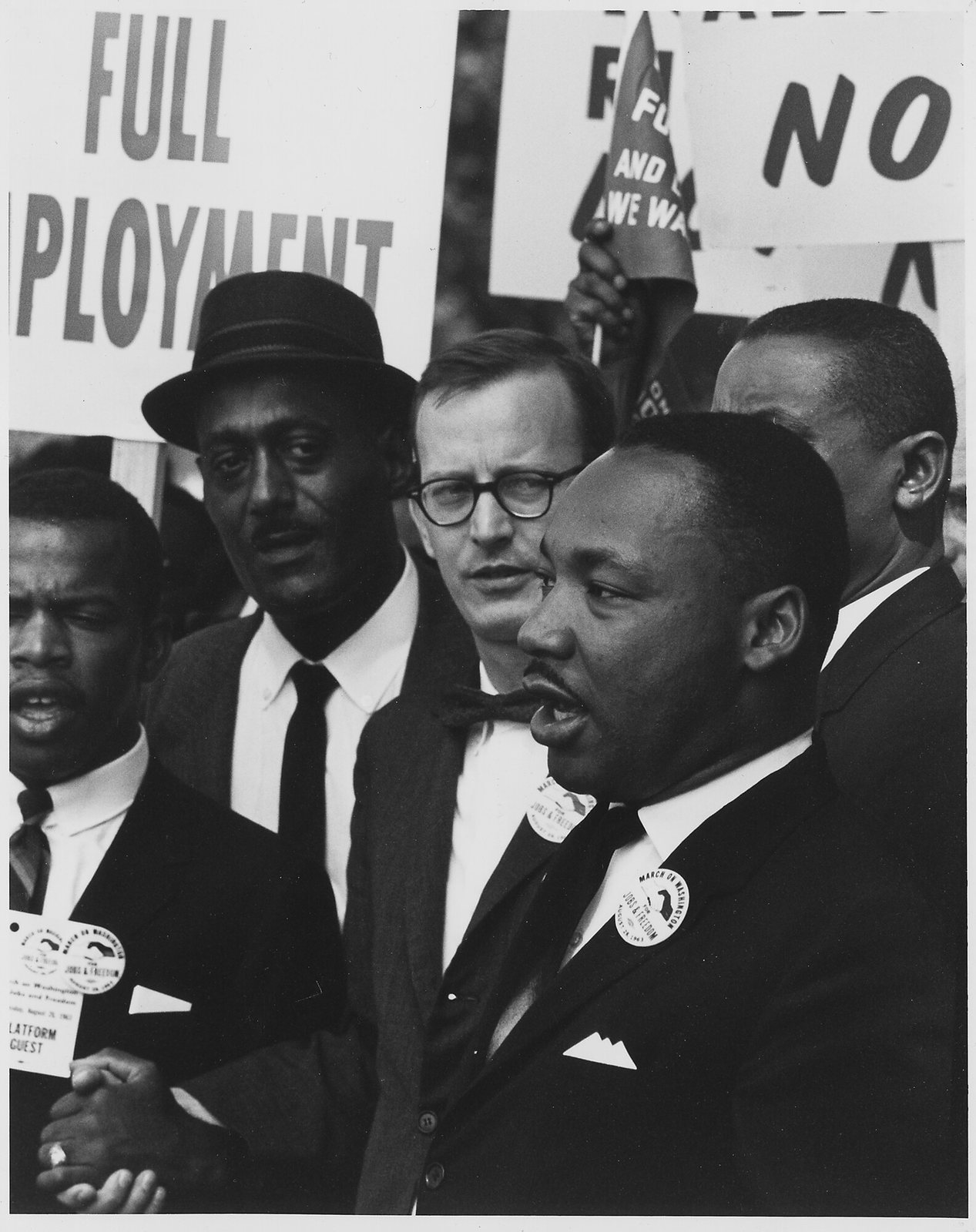
  • Black-and-white photograph of Martin Luther King Jr., wearing a march badge, among men in suits and hats, with protest signs reading "Full Employment" behind them. (view at the source, opens in a new tab)
    August 28, 1963King amid the crowd at the March on Washington for Jobs and Freedom, beside Mathew Ahmann of the National Catholic Conference for Interracial Justice.U.S. Information Agency. National Archives and Records Administration (306-SSM-4C-51-13).
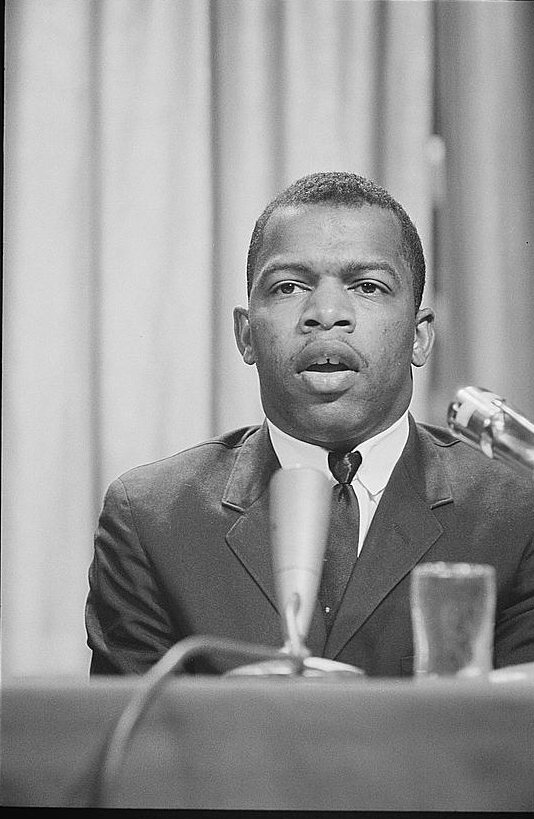
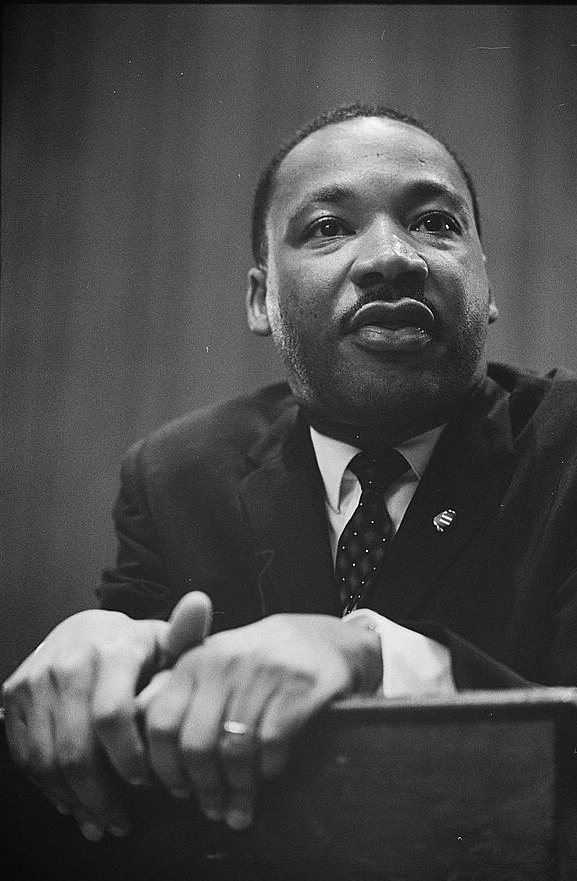
  • Black-and-white photograph of Martin Luther King Jr. leaning forward with his hands clasped over the edge of a lectern, looking off to one side. (view at the source, opens in a new tab)
    March 26, 1964King at a press conference in the U.S. Capitol.Marion S. Trikosko, U.S. News & World Report. Library of Congress, Prints and Photographs Division (LC-U9-11696, frame 9A).
  • Black-and-white photograph of Martin Luther King Jr., half-length in a dark suit and tie, raising his right hand as he speaks, with a candle sconce on the wall behind him. (view at the source, opens in a new tab)
    1964New York World-Telegram & Sun staff photograph from 1964, the year King received the Nobel Peace Prize.Dick DeMarsico, New York World-Telegram & Sun. Library of Congress, Prints and Photographs Division (LC-USZ62-126559).

Key moments

Martin Luther King Jr.’s life in time

  1. 1929

    Born Michael King Jr. on January 15 in Atlanta, Georgia.

  2. 1953

    June 18: marries Coretta Scott.

  3. 1954

    Becomes pastor of Dexter Avenue Baptist Church in Montgomery.

  4. 1955

    Earns his doctorate. December 5: elected president of the Montgomery Improvement Association.

  5. 1956

    January 30: his home is bombed. December 21: rides Montgomery’s integrated buses.

  6. 1957

    Becomes president of the Southern Christian Leadership Conference.

  7. 1961

    October 16: urges President Kennedy to issue a second Emancipation Proclamation.

  8. 1963

    April 16: writes “Letter from Birmingham Jail.” August 28: delivers “I Have a Dream.”

  9. 1964

    December 10: accepts the Nobel Peace Prize in Oslo.

  10. 1965

    Leads the march from Selma to Montgomery. August 6: the Voting Rights Act is signed.

  11. 1967

    April 4: speaks against the Vietnam War at Riverside Church.

  12. 1968

    April 4: assassinated at the Lorraine Motel in Memphis.

June 19, 1865

Connection to Juneteenth

On June 19, 1865, Union troops at Galveston, Texas, announced General Order No. 3, which told the people of Texas that all enslaved people were free. The Emancipation Proclamation had taken effect two and a half years earlier; in Texas, freedom waited for the Union Army. Juneteenth is, at its heart, a day about freedom delayed, and Martin Luther King Jr. spent his public life arguing against delay. Writing from the Birmingham jail in April 1963 to white clergymen who had urged patience, he answered with an old maxim of the law, which he credited to a distinguished jurist: justice too long delayed is justice denied.

He measured his own era against emancipation’s promise. In 1961 he urged President John F. Kennedy to issue a second Emancipation Proclamation, and on May 17, 1962, he sent Kennedy a 75-page appeal asking for a national rededication to the principles of the Emancipation Proclamation and for an executive order prohibiting segregation, as the Proclamation’s centennial approached. At the March on Washington in August 1963, in the centennial year, he opened by recalling the Proclamation itself. It had come, he said, “as a joyous daybreak to end the long night of their captivity.” And yet “one hundred years later, the Negro still is not free.”

His fight for the vote also reached back to Reconstruction. The Fifteenth Amendment had barred racial discrimination at the polls in 1870, but across much of the South poll taxes, literacy tests and violence had nullified it for generations. In 1957, at the Lincoln Memorial, King gave his first national address, “Give Us the Ballot.” In 1965, after the march from Selma to Montgomery, President Lyndon B. Johnson signed the Voting Rights Act, ninety-five years after the Fifteenth Amendment was ratified.

King did not live to see Juneteenth become a national holiday, but his last campaign became part of the holiday’s story. After his assassination in April 1968, his colleagues carried on the Poor People’s Campaign he had planned. Its largest event, a Solidarity Day rally at the Lincoln Memorial, took place on June 19, 1968 – Juneteenth – and drew more than 50,000 people; Coretta Scott King was among the speakers. Encyclopaedia Britannica notes that Juneteenth celebrations declined in the 1960s, overshadowed by the civil rights movement, and that the day regained importance with the campaign’s Juneteenth Solidarity Day. In 2021 Juneteenth became the first new federal holiday since the one created in King’s honor in 1983.

Sources

Where this story comes from

Every fact on this page is drawn from the sources listed here. Quotations are given as they were first recorded.

  1. Major King Events Chronology: 1929–1968 (opens in a new tab)Martin Luther King, Jr. Research and Education Institute, Stanford University
  2. King, Martin Luther, Jr., by Clayborne Carson (American National Biography) (opens in a new tab)Stanford University
  3. “I Have a Dream” (opens in a new tab)Martin Luther King, Jr. Research and Education Institute, Stanford University
  4. “I Have a Dream” (transcript) (opens in a new tab)National Park Service
  5. I Have A Dream (transcript from the King Institute’s “Freedom’s Ring”) (opens in a new tab)Teaching American History
  6. Montgomery Bus Boycott (opens in a new tab)Martin Luther King, Jr. Research and Education Institute, Stanford University
  7. Nobel Peace Prize (opens in a new tab)Martin Luther King, Jr. Research and Education Institute, Stanford University
  8. Martin Luther King Jr. – Prize presentation, Nobel Peace Prize 1964 (opens in a new tab)NobelPrize.org
  9. Voting Rights Act of 1965 (opens in a new tab)Martin Luther King, Jr. Research and Education Institute, Stanford University
  10. Selma Marches (opens in a new tab)National Archives
  11. Senate Passes Voting Rights Act (opens in a new tab)United States Senate, Senate Historical Office
  12. What Goes into Making a Federal Holiday: Ronald Reagan and Martin Luther King, Jr. Day (opens in a new tab)National Archives, Ronald Reagan Presidential Library
  13. Emancipation Proclamation (opens in a new tab)Martin Luther King, Jr. Research and Education Institute, Stanford University
  14. Martin Luther King Jr., “Letter from Birmingham Jail,” 1963 (text) (opens in a new tab)Bill of Rights Institute
  15. Resurrection City (opens in a new tab)National Park Service
  16. How did the American civil rights movement affect Juneteenth celebrations? (opens in a new tab)Encyclopaedia Britannica
  17. Biden signs bill making Juneteenth a federal holiday (opens in a new tab)Axios (June 17, 2021)

Portraits: U, August 28, 1963; Marion S, March 26, 1964; Dick DeMarsico, New York World-Telegram & Sun, 1964. Public domain in the United States.