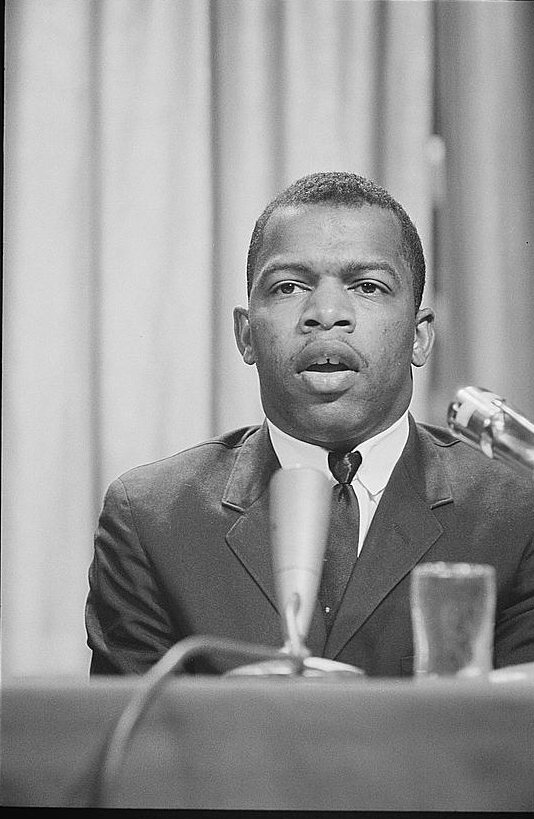
Black-and-white photograph of a young John Lewis in a suit and tie, seated behind a microphone at a table and speaking, with a curtain behind him.

John Lewis

1940 – 2020

Freedom Rider who helped lead the 1965 Selma march, then served 33 years in Congress.

Draft for committee review

A sharecropper’s son

John Robert Lewis was born on February 21, 1940, on a farm near Troy, in Pike County, Alabama. His parents were sharecroppers. As a boy he looked after the family’s chickens on land his grandfather had bought. At ten he asked for a card at the Pike County Public Library and was refused because he was Black. Nearly fifty years later, on July 5, 1998, the library gave him one.

In 1955 he heard Martin Luther King Jr. preach on the radio, and he followed the Montgomery bus boycott, about fifty miles from home. In 1957 he applied to all-white Troy State and received no reply. He enrolled instead at the American Baptist Theological Seminary in Nashville. He wrote to King, met Rosa Parks in 1957, and met King in Montgomery in 1958.

Nashville and the Freedom Rides

In Nashville, Lewis studied nonviolence in workshops led by James Lawson. In early 1960 he joined other students in sit-ins at segregated lunch counters, theaters and restaurants, and the city’s lunch counters were desegregated. That April he helped found the Student Nonviolent Coordinating Committee, known as SNCC.

In May 1961 Lewis was among the first Freedom Riders, thirteen Black and white travelers who set out by bus from Washington, D.C., for New Orleans to challenge segregation at interstate bus terminals. At Rock Hill, South Carolina, he and another rider were beaten. Later that month he was attacked again at the bus station in Montgomery, Alabama. The attacks drew national attention and pressed the federal government to enforce the law against segregated interstate travel.

Democracy is not a state. It is an act, and each generation must do its part to help build what we called the Beloved Community, a nation and world society at peace with itself.

John Lewis, “Together, You Can Redeem the Soul of Our Nation,” The New York Times, July 30, 2020

Chairman of SNCC

In 1963 SNCC chose Lewis as its chairman, a post he held until 1966. On August 28, 1963, at the March on Washington for Jobs and Freedom, he was, at 23, the youngest speaker. Other leaders of the march asked him to revise his text, which bluntly criticized the federal government, and he did.

Under his leadership SNCC ran Freedom Schools, organized the 1964 Mississippi Freedom Summer Project and worked to register Black voters across the Deep South.

Selma, 1965

In Alabama, literacy tests and other barriers kept most Black citizens from registering to vote. On Sunday, March 7, 1965, Lewis and Hosea Williams of the Southern Christian Leadership Conference led about 600 marchers from Brown Chapel A.M.E. Church in Selma toward Montgomery, the state capital. At the Edmund Pettus Bridge, Alabama state troopers and men on horseback ordered them to disperse, then attacked with clubs and tear gas. Many marchers were injured, and Lewis suffered a fractured skull. Film of the attack was broadcast across the nation, and the day became known as Bloody Sunday.

On March 21 the march set out again from Brown Chapel, and on March 25 thousands reached the Alabama state capitol. On August 6, 1965, President Lyndon B. Johnson signed the Voting Rights Act, which outlawed literacy tests and barred any voting practice that denied the vote “on account of race or color.”

In 1966 Stokely Carmichael won the chairmanship of SNCC as the group moved away from strict nonviolence. Lewis, who held to nonviolence, left the organization.

Thirty-three years in Congress

Lewis completed a degree at Fisk University in 1967 and in 1968 married Lillian Miles, a librarian. He went on to direct the Voter Education Project of the Southern Regional Council and to serve as an associate director of ACTION, the federal volunteer agency. In 1981 he won a seat on the Atlanta City Council.

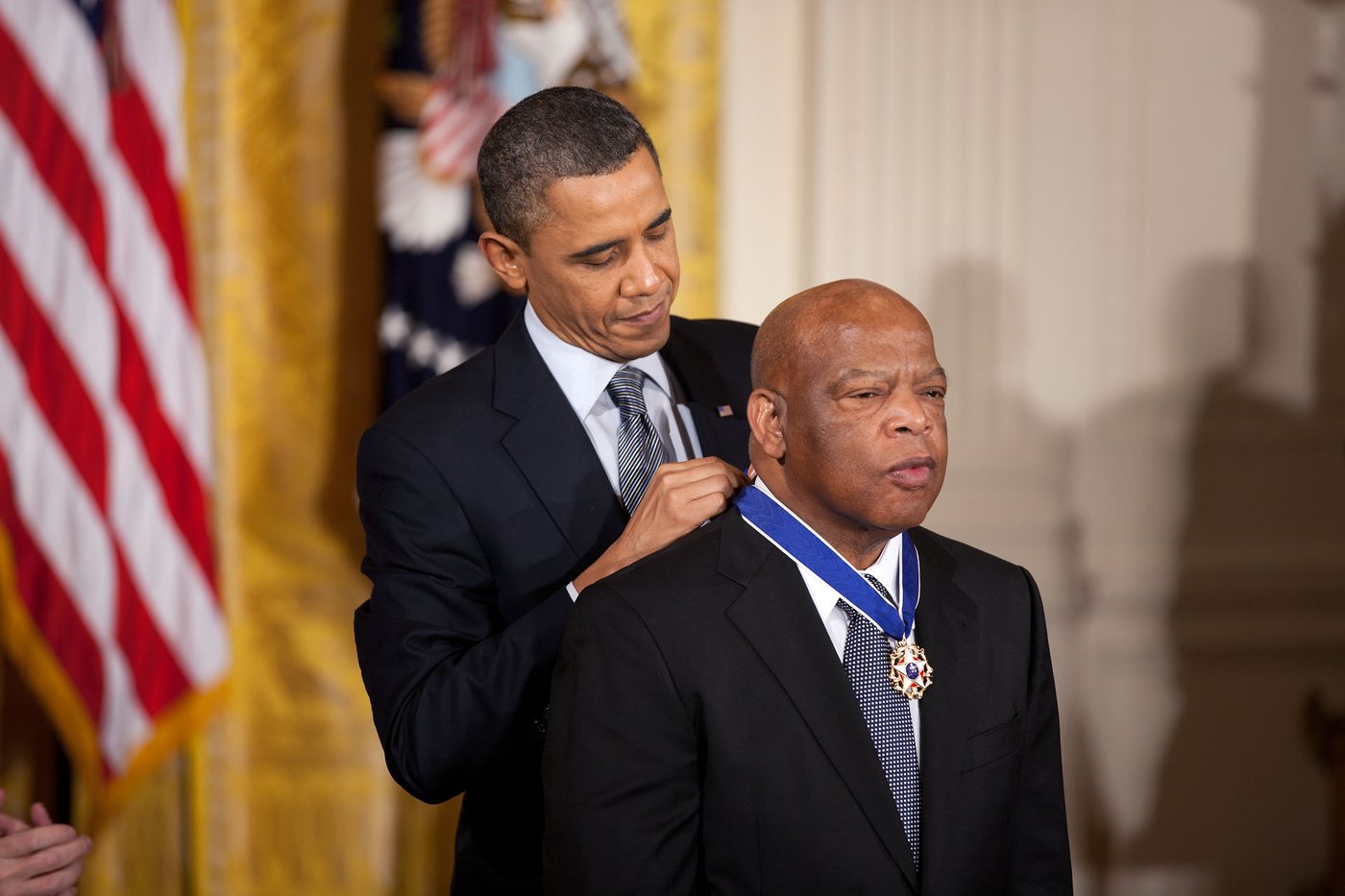
In 1986 he defeated Julian Bond, a fellow SNCC veteran, in a Democratic primary runoff, then won the general election. He represented Georgia’s 5th district from January 3, 1987, until his death, and he regularly led members of Congress on pilgrimages to Selma and other Alabama civil rights sites. On February 15, 2011, President Barack Obama presented him the Presidential Medal of Freedom, noting that he was known as “the conscience of the United States Congress.” With collaborators he told the movement’s story in March, a graphic-novel trilogy; its third book won the National Book Award in 2016.

John Lewis died of pancreatic cancer in Atlanta on July 17, 2020. On July 27 and 28 he lay in state at the U.S. Capitol. On July 30, The New York Times published an essay he had written shortly before his death.
In the archive

Three portraits

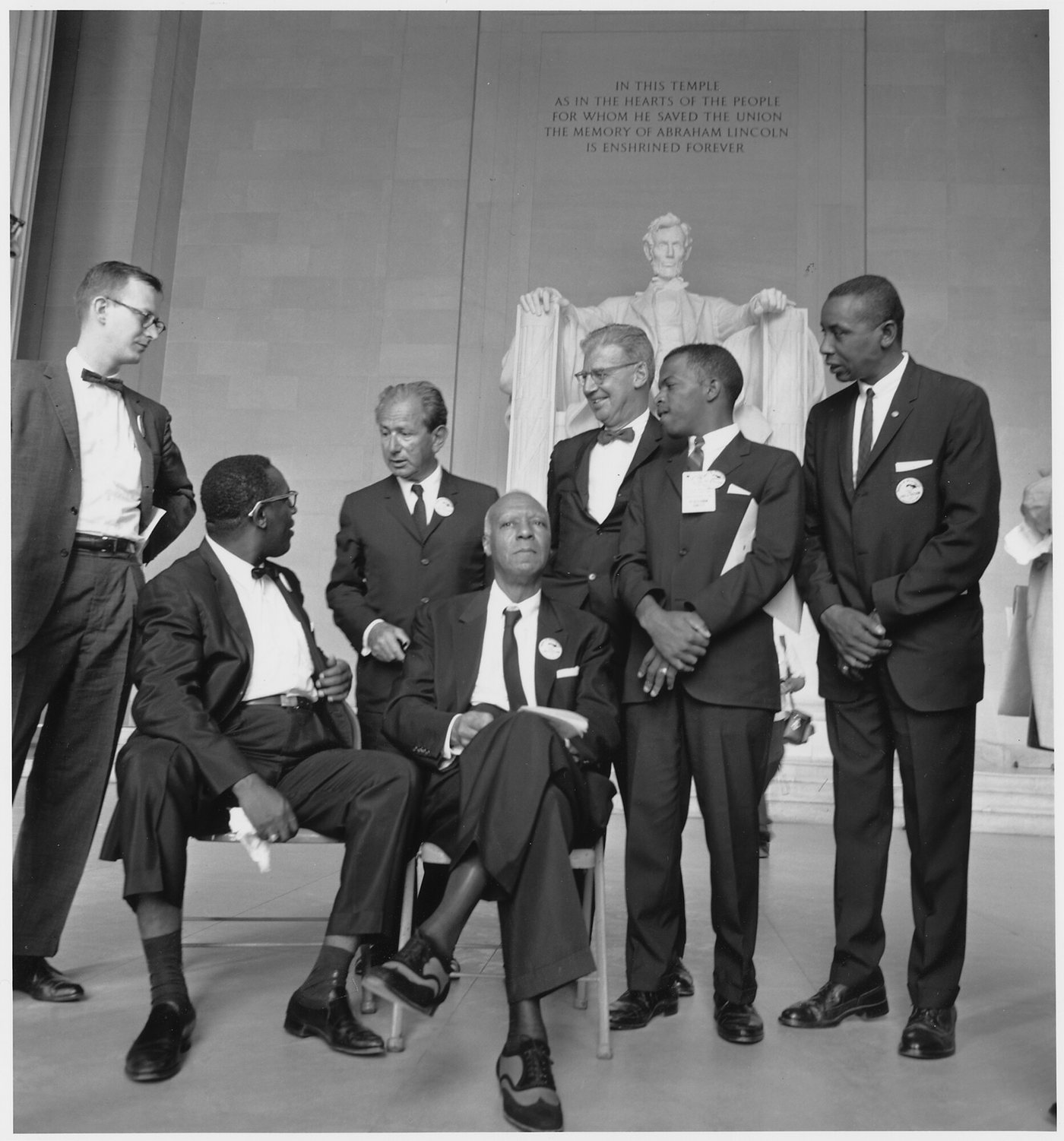
  • Black-and-white group photograph of seven men in suits beneath the statue of Abraham Lincoln and its inscription, two of them seated; a young John Lewis, wearing a badge, stands second from right with hands clasped. (view at the source, opens in a new tab)
    August 28, 1963Leaders of the March on Washington at the Lincoln Memorial; John Lewis, the 23-year-old chairman of the Student Nonviolent Coordinating Committee, stands second from right.U.S. Information Agency. National Archives and Records Administration (306-SSM-4D-91-9).
  • Black-and-white photograph of a young John Lewis in a suit and tie, seated behind a microphone at a table and speaking, with a curtain behind him. (view at the source, opens in a new tab)
    April 16, 1964Lewis, then chairman of SNCC, speaking at a meeting of the American Society of Newspaper Editors.Marion S. Trikosko, U.S. News & World Report. Library of Congress, Prints and Photographs Division (LC-U9-11812, frame 26).
  • Color photograph of President Obama fastening the Presidential Medal of Freedom around the neck of John Lewis, who stands with eyes lowered in front of an American flag. (view at the source, opens in a new tab)
    February 15, 2011President Barack Obama awards Congressman Lewis the 2010 Presidential Medal of Freedom in the East Room of the White House.White House Photo Office (Obama Administration). Barack Obama Presidential Library, National Archives and Records Administration.

Key moments

John Lewis’s life in time

  1. 1940

    Born February 21 near Troy, Pike County, Alabama.

  2. 1960

    Joins the Nashville sit-ins. In April, helps found SNCC.

  3. 1961

    Rides with the first Freedom Riders; beaten at Rock Hill, South Carolina, and in Montgomery, Alabama.

  4. 1963

    Becomes chairman of SNCC. August 28: the youngest speaker at the March on Washington.

  5. 1965

    March 7: co-leads the march at the Edmund Pettus Bridge, Selma. August 6: the Voting Rights Act is signed.

  6. 1966

    Leaves SNCC after Stokely Carmichael wins its chairmanship.

  7. 1981

    Elected to the Atlanta City Council.

  8. 1987

    January 3: takes his seat in the U.S. House for Georgia’s 5th district.

  9. 2011

    February 15: receives the Presidential Medal of Freedom from President Obama.

  10. 2016

    His graphic memoir March: Book Three wins the National Book Award.

  11. 2020

    Dies July 17 in Atlanta; lies in state at the U.S. Capitol, July 27–28.

June 19, 1865

Connection to Juneteenth

On June 19, 1865, Union troops at Galveston, Texas, announced that all enslaved people in the state were free. For John Lewis, that history was family history. In 2012, for the PBS series Finding Your Roots, the historian Henry Louis Gates Jr. traced his family back to ancestors who had been enslaved. He showed Lewis the marriage certificate of his great-great-grandparents, Tobias and Elizabeth Carter, dated December 16, 1865, ten days after the Thirteenth Amendment abolishing slavery was ratified. The researchers had also found Tobias Carter’s voter registration, from Alabama in 1867, during Reconstruction. Lewis, who had suffered a fractured skull marching for the right to vote, wept when he saw it.

The promise of those years did not hold. The Fifteenth Amendment of 1870 barred states from denying the vote on account of race, but across much of the South, literacy tests, poll taxes and violence kept most Black citizens from the polls for nearly a century. Lewis grew up in that world. As a boy in Pike County, Alabama, he was refused even a library card because he was Black.

On March 7, 1965, he walked at the head of the march across the Edmund Pettus Bridge in Selma, a bridge named for a Confederate general, and was beaten by state troopers. On March 25 he spoke from the platform at the Alabama State Capitol when the march reached Montgomery. On August 6, President Lyndon B. Johnson signed the Voting Rights Act, ninety-five years after the Fifteenth Amendment was ratified. In thirty-three years in the House, Lewis led members of Congress back to Selma again and again, keeping that memory alive for lawmakers who had not lived it.

On July 26, 2020, nine days after his death, a horse-drawn carriage carried his casket across the Edmund Pettus Bridge one last time. Four days later The New York Times published an essay he had written shortly before he died. In it he made the case he had made all his life: “The vote is the most powerful nonviolent change agent you have in a democratic society.” Juneteenth is a day for handing down the story of freedom. Lewis found his own family in its first chapter, lived through one of its hardest, and used his last words to pass it on.

Sources

Where this story comes from

Every fact on this page is drawn from the sources listed here. Quotations are given as they were first recorded.

  1. The Honorable John R. Lewis, U.S. Representative of Georgia (1987–2020) (opens in a new tab)U.S. House of Representatives, Office of the Historian, Oral History
  2. Lewis, John (opens in a new tab)Martin Luther King, Jr. Research and Education Institute, Stanford University
  3. John Robert Lewis, SNCC Founder and Chairman, Civil Rights Leader and Congressman, Dies at 80 (opens in a new tab)Martin Luther King, Jr. Research and Education Institute, Stanford University
  4. Freedom Rides (opens in a new tab)Martin Luther King, Jr. Research and Education Institute, Stanford University
  5. Recounting the Civil Rights Movement (Information Bulletin, March 1999) (opens in a new tab)Library of Congress
  6. Bloody Sunday (opens in a new tab)National Park Service, Selma to Montgomery National Historic Trail
  7. Selma Marches (opens in a new tab)National Archives
  8. 15th Amendment to the U.S. Constitution: Voting Rights (1870) (opens in a new tab)National Archives, Milestone Documents
  9. Voting Rights Act (1965) (opens in a new tab)National Archives, Milestone Documents
  10. John Lewis (1940–2020) (opens in a new tab)New Georgia Encyclopedia
  11. Remarks on Presenting the Presidential Medal of Freedom, February 15, 2011 (opens in a new tab)The American Presidency Project, UC Santa Barbara
  12. Lying in State or in Honor (opens in a new tab)Architect of the Capitol
  13. John Lewis digs through his roots on PBS’s ‘Finding Your Roots’ (opens in a new tab)The Atlanta Journal-Constitution
  14. Finding Your Roots, Episode 102: Cory Booker and John Lewis (opens in a new tab)PBS Pressroom
  15. 13th Amendment to the U.S. Constitution: Abolition of Slavery (1865) (opens in a new tab)National Archives, Milestone Documents
  16. Edmund Pettus (opens in a new tab)Encyclopedia of Alabama
  17. Alabama State Capitol (opens in a new tab)National Park Service
  18. In Selma, a ‘Final Crossing’ for John Lewis Across the Edmund Pettus Bridge (opens in a new tab)NPR, via WHYY (July 26, 2020)
  19. John Lewis, “Together, You Can Redeem the Soul of Our Nation” (2020) (text) (opens in a new tab)Bill of Rights Institute

Portraits: U, August 28, 1963; Marion S, April 16, 1964; White House Photo Office (Obama Administration), February 15, 2011. Public domain in the United States.