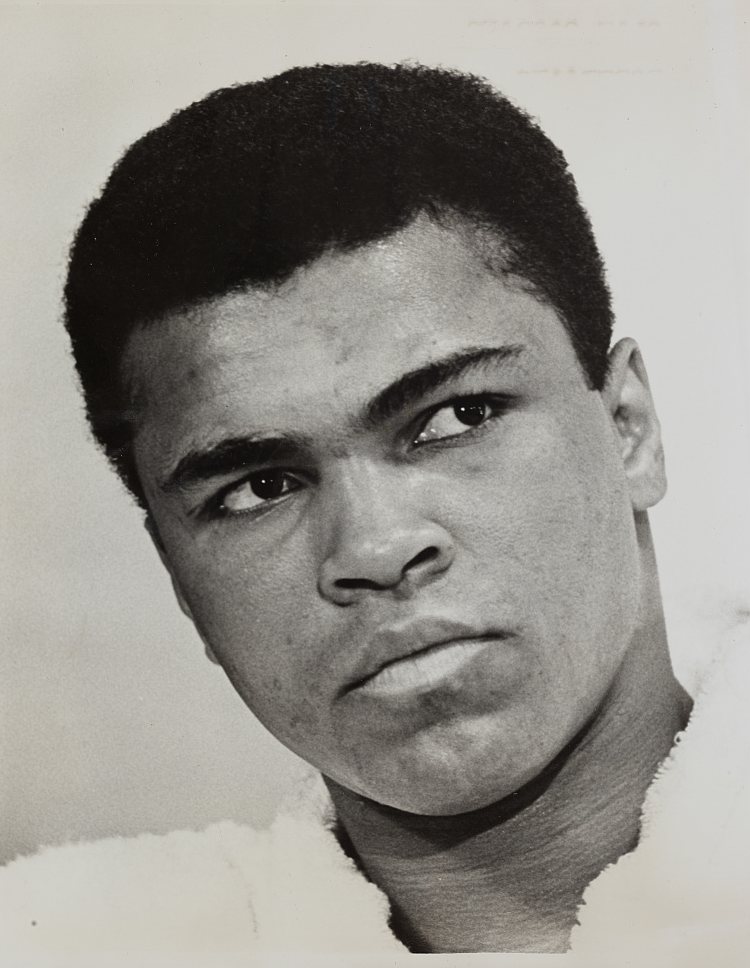
Black-and-white head-and-shoulders portrait of a young Muhammad Ali with short hair, looking intently to the side.

Muhammad Ali

1942 – 2016

Three-time heavyweight champion who stood by his conscience at great personal cost.

Draft for committee review

Cassius Clay of Louisville

Muhammad Ali was born Cassius Marcellus Clay Jr. on January 17, 1942, in Louisville, Kentucky. On October 11, 1954, when he was 12, his red bicycle was stolen outside the Louisville Home Show. He reported the theft to a police officer, Joe Martin, who also trained young boxers. Martin suggested that he learn to fight first.

As an amateur he won 134 bouts and lost 7, with Golden Gloves and national titles along the way. On September 5, 1960, at 18, he won the light heavyweight gold medal at the Olympic Games in Rome. He turned professional that October. In his first professional fight, on October 29, 1960, in Louisville, he beat Tunney Hunsaker over six rounds, and the proceeds went to a children’s hospital.

A new name

On February 25, 1964, in Miami Beach, he took the heavyweight championship from Sonny Liston, who had been a heavy favorite. The next day he announced that he was a Muslim, a member of the Nation of Islam, and soon afterward its leader, Elijah Muhammad, gave him the name Muhammad Ali. He defended the title nine times over the next three years. On May 25, 1965, in Lewiston, Maine, he knocked Liston out in the first round of their rematch, and on February 6, 1967, in Houston, he beat Ernie Terrell over fifteen rounds.

…I have only two alternatives in taking this stand: either I go to jail or go to the Army. There is another alternative and that alternative is justice.

Muhammad Ali, prepared statement handed out at the induction station in Houston, April 28, 1967, as quoted by the Federal Judicial Center

A stand of conscience

In February 1966, during the Vietnam War, his draft board in Louisville classified him as eligible for induction. Ali sought exemption as a minister of his faith and as a conscientious objector. A hearing officer concluded that his religious objection to war was sincere, but the Justice Department advised against him, and his appeals failed.

On April 28, 1967, at the induction station in Houston, Texas, Ali refused to step forward when his name was called. The New York State Athletic Commission suspended his boxing license that day, other licensing bodies followed, and he was stripped of his title. His trial in federal court in Houston opened on June 19, 1967, and the next day a jury found him guilty. He was sentenced to five years in prison and a $10,000 fine, and remained free on bail while he appealed. The court also ordered him to surrender his passport, so he could not fight abroad. In May 1968 the Court of Appeals for the Fifth Circuit upheld his conviction.

In 1970 a federal court found that New York had unfairly singled him out, and Ali regained the right to fight. On March 8, 1971, he lost to Joe Frazier in New York, his first professional defeat. On June 28, 1971, the Supreme Court unanimously reversed his conviction. Justice Thurgood Marshall took no part in the case, because he had been solicitor general when the Justice Department wrote its advice in the case.

Three times champion

On October 30, 1974, in Kinshasa, Zaire, Ali knocked out George Foreman in the eighth round and won back the heavyweight title. On October 1, 1975, he beat Frazier in Manila. He lost the title to Leon Spinks in February 1978, then won it back on September 15 in New Orleans, the first heavyweight to win the championship three times. He lost to Larry Holmes in 1980, and his last fight, a loss to Trevor Berbick in Nassau, Bahamas, came on December 11, 1981. He finished with 56 wins and 5 losses.

In 1984 Ali was diagnosed with Parkinson’s disease. In 1986 he married Yolanda “Lonnie” Williams, in Louisville. In 1990 he negotiated the release of 15 Americans held hostage in Iraq. On July 19, 1996, he lit the cauldron to open the Summer Olympic Games in Atlanta, and in 1998 the United Nations named him a Messenger of Peace.

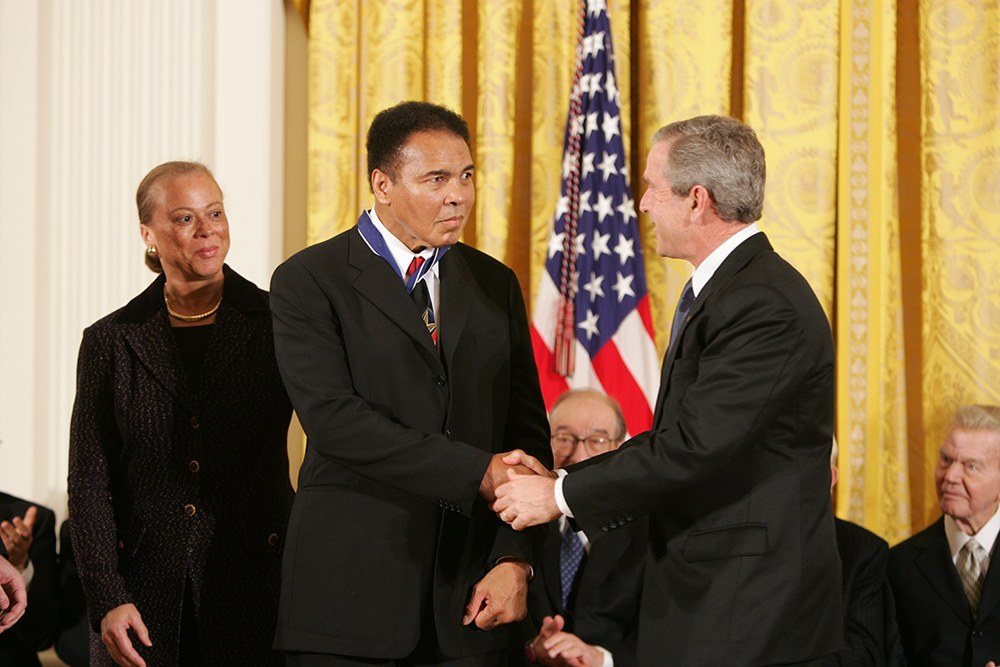
On November 9, 2005, President George W. Bush awarded him the Presidential Medal of Freedom, and ten days later the Muhammad Ali Center opened in Louisville. Muhammad Ali died in Scottsdale, Arizona, on June 3, 2016. He was 74.
In the archive

Three portraits

  • Black-and-white head-and-shoulders portrait of a young Muhammad Ali with short hair, looking intently to the side. (view at the source, opens in a new tab)
    1967Muhammad Ali, photographed for the New York World-Telegram & Sun in 1967.Ira Rosenberg, World-Telegram staff photographer. Library of Congress Prints and Photographs Division, New York World-Telegram & Sun Newspaper Photograph Collection (LC-USZ62-115435; digital file LC-DIG-ds-13998).
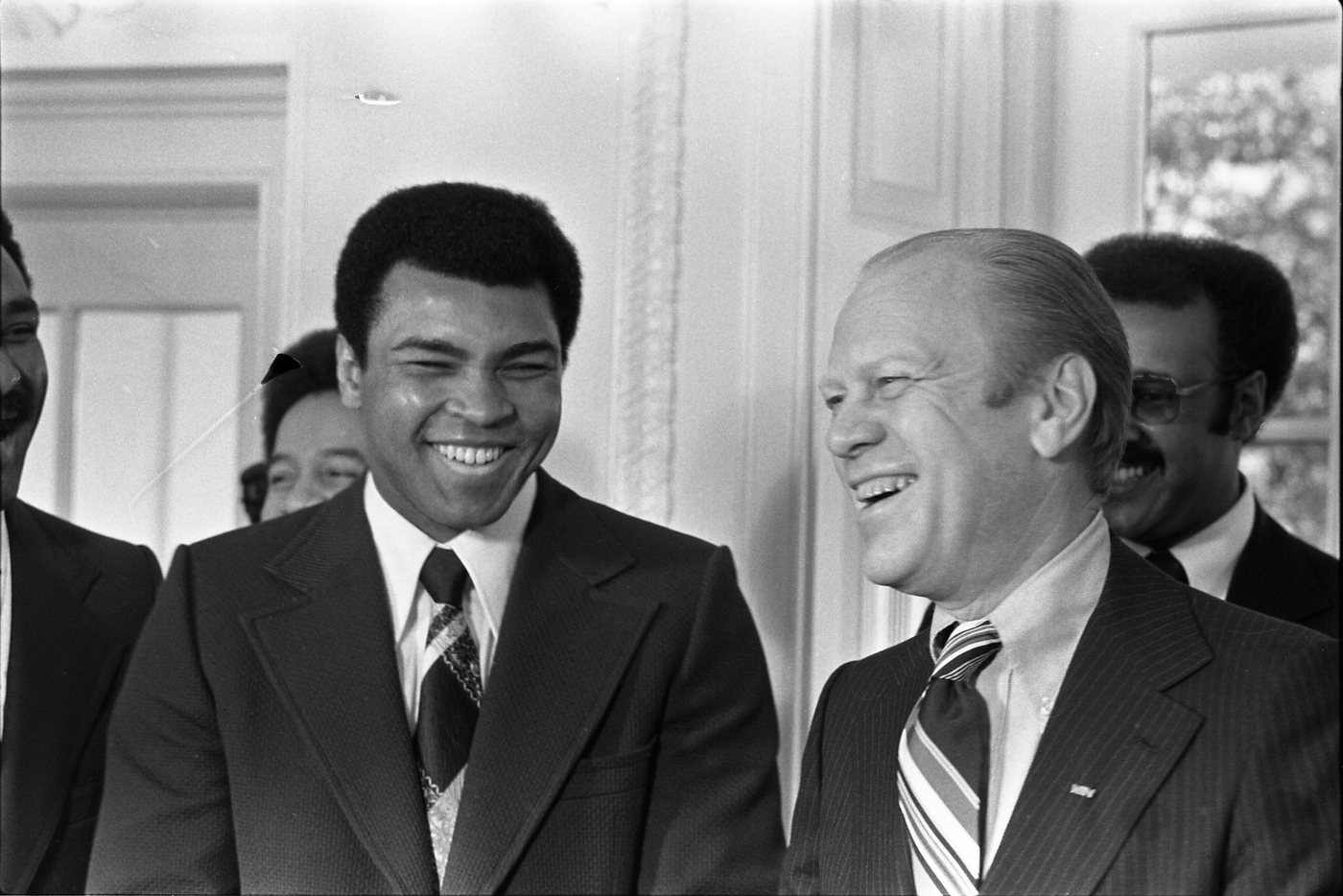
  • Black-and-white photograph of Muhammad Ali in a suit and tie laughing alongside a laughing President Ford, with other men behind them. (view at the source, opens in a new tab)
    December 10, 1974Muhammad Ali visits President Gerald R. Ford in the Oval Office.White House Photographic Office (Ford Administration). Gerald R. Ford Presidential Library, National Archives (GRF-WHPO-A2367-32).
  • Color photograph of Muhammad Ali, wearing the Medal of Freedom on a blue ribbon, shaking hands with President Bush in front of gold curtains and an American flag, with Lonnie Ali standing beside him. (view at the source, opens in a new tab)
    November 9, 2005As Lonnie Ali looks on, President George W. Bush shakes hands with Muhammad Ali after presenting him the Presidential Medal of Freedom.White House Photo Office (George W. Bush Administration). George W. Bush Presidential Library, National Archives (P110905PM-0245).

Key moments

Muhammad Ali’s life in time

  1. 1942

    Born Cassius Marcellus Clay Jr. on January 17 in Louisville, Kentucky.

  2. 1954

    After his bicycle is stolen, begins training with police officer Joe Martin.

  3. 1960

    September 5: wins Olympic gold in Rome.

  4. 1964

    February 25: wins the heavyweight title from Sonny Liston; takes the name Muhammad Ali.

  5. 1967

    April 28: refuses induction in Houston and is stripped of his title. June 20: convicted.

  6. 1971

    March 8: loses to Joe Frazier. June 28: the Supreme Court reverses his conviction.

  7. 1974

    October 30: knocks out George Foreman in Kinshasa to regain the title.

  8. 1978

    September 15: beats Leon Spinks to become champion a third time.

  9. 1984

    Diagnosed with Parkinson’s disease.

  10. 1996

    July 19: lights the Olympic cauldron in Atlanta.

  11. 2005

    Receives the Presidential Medal of Freedom; the Muhammad Ali Center opens.

  12. 2016

    Dies on June 3 in Scottsdale, Arizona.

June 19, 1865

Connection to Juneteenth

Muhammad Ali was born in Louisville, Kentucky, in a state where slavery outlasted Juneteenth. Kentucky was a slaveholding state that stayed in the Union, and the Emancipation Proclamation did not reach it; its General Assembly rejected every federal emancipation measure, the proclamation included. On June 19, 1865, when freedom was announced at Galveston, people in Kentucky were still held in bondage. Slavery there ended only when the Thirteenth Amendment was ratified in December 1865. Kentucky itself did not adopt the amendment until 1976.

He was born with a name drawn from that history. His grandfather, Herman Heaton Clay, had named Ali’s father in tribute to Cassius Marcellus Clay, a Kentucky abolitionist who had heard William Lloyd Garrison speak while a student at Yale and later published an antislavery newspaper, the True American, in Lexington. Ali, who announced in 1964 that he had joined the Nation of Islam, saw the name differently. “Cassius Clay is a slave name,” he said. “I didn’t choose it and I don’t want it. I am Muhammad Ali, a free name.” A century earlier, people freed from slavery had faced the same question. As the Smithsonian’s National Museum of African American History and Culture puts it, “Freedom provided an opportunity and a choice: select a new name, or retain the old one.” Many chose new names to mark their new status and to decide for themselves how they would be addressed.

His sharpest trial came in Texas. In 1967 Ali refused induction into the Army at Houston, where he had moved during his draft case, on the ground that his faith forbade him to fight. His trial in federal court there opened on June 19, 1967, by coincidence the 102nd anniversary of the day the news of freedom reached Galveston. A jury of six men and six women, all of them white, found him guilty in about twenty minutes, and the judge imposed the maximum sentence.

Ali lost his title and three and a half years in the ring: he did not fight again until October 26, 1970. In 1971 the Supreme Court unanimously reversed his conviction. Juneteenth remembers that freedom declared is not yet freedom secured, and that the gap is often closed only by people who refuse to give way. Ali’s stand, on his name, his faith and his conscience, belongs to that long history.

Sources

Where this story comes from

Every fact on this page is drawn from the sources listed here. Quotations are given as they were first recorded.

  1. U.S. v. Clay: Muhammad Ali’s Fight Against the Draft (opens in a new tab)Federal Judicial Center
  2. Principal Questions in Clay v. United States (1968) (opens in a new tab)National Archives, DocsTeach
  3. U.S. Reports: Clay v. United States, 403 U.S. 698 (1971) (opens in a new tab)Library of Congress
  4. The Timeline (opens in a new tab)Muhammad Ali Center
  5. Boxing Timeline (opens in a new tab)Muhammad Ali Center
  6. President Honors Recipients of the Presidential Medal of Freedom (November 9, 2005) (opens in a new tab)The White House, President George W. Bush (archived)
  7. Muhammad Ali (opens in a new tab)Encyclopaedia Britannica
  8. Muhammad Ali summary (opens in a new tab)Encyclopaedia Britannica
  9. African American Refugees and Emancipation (opens in a new tab)National Park Service, Camp Nelson National Monument
  10. Union Forever and Slavery (opens in a new tab)National Park Service, Camp Nelson National Monument
  11. 13th Amendment to the U.S. Constitution: Abolition of Slavery (1865) (opens in a new tab)National Archives, Milestone Documents
  12. Muhammad Ali, originally named for ardent abolitionist and Yale alumnus Cassius Clay (June 9, 2016) (opens in a new tab)Yale University, YaleNews
  13. Before Muhammad Ali: Who Was the Original Cassius Clay?, by Arica Coleman (June 10, 2016) (opens in a new tab)TIME
  14. Visions of Freedom: Searching for Family (opens in a new tab)Smithsonian National Museum of African American History and Culture, Searchable Museum

Portraits: Ira Rosenberg, World-Telegram staff photographer, 1967; White House Photographic Office (Ford Administration), December 10, 1974; White House Photo Office (George W, November 9, 2005. Public domain in the United States.