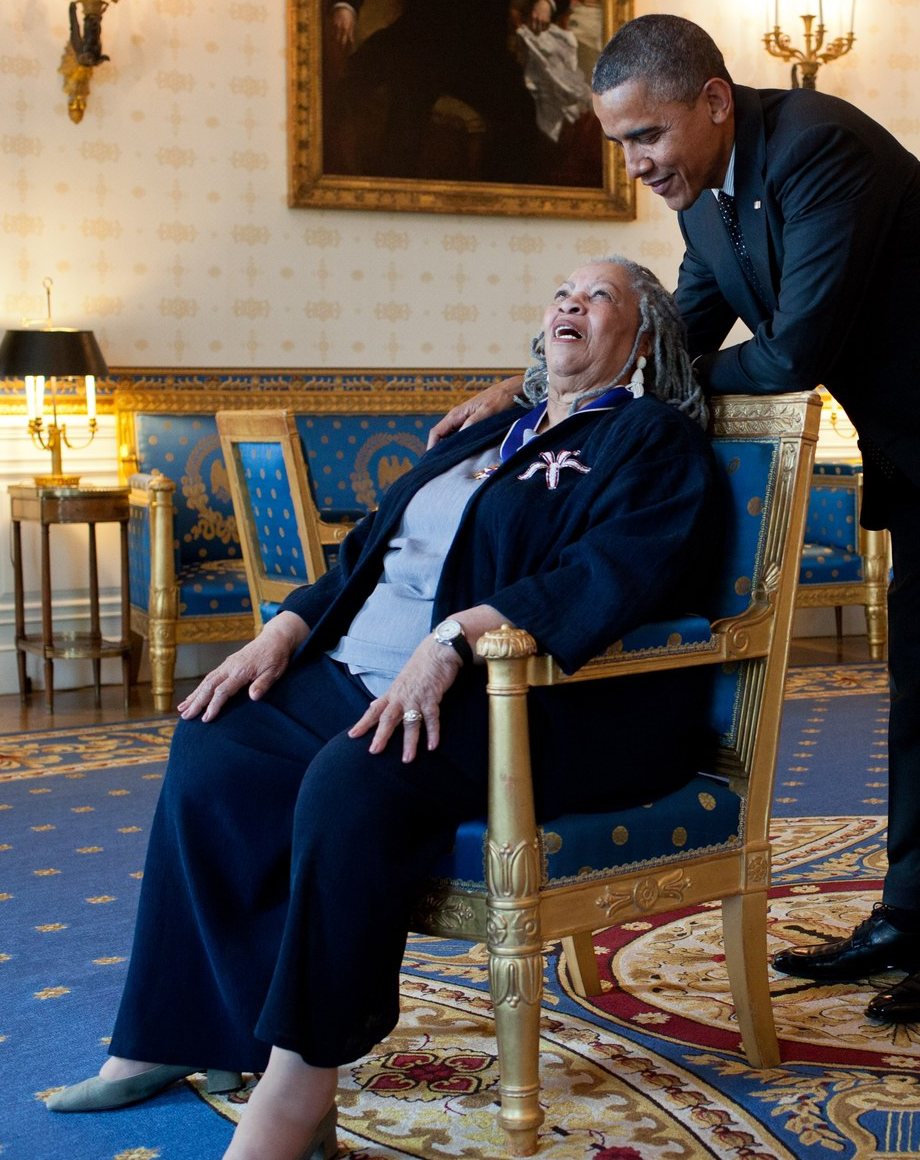
Color photograph of Toni Morrison, gray hair pulled back and wearing the Medal of Freedom, laughing in a gilded chair as President Obama leans over with a hand on her shoulder in the White House Blue Room.

Toni Morrison

1931 – 2019

Novelist; Nobel Prize in Literature, 1993.

Draft for committee review

Chloe Wofford of Lorain

Toni Morrison was born Chloe Ardelia Wofford on February 18, 1931, in Lorain, Ohio, a steel-mill town west of Cleveland. At 12 she joined the Roman Catholic Church and took Anthony as her baptismal name. At Howard University, where she earned a bachelor’s degree in English in 1953, she began to go by Toni. She earned a master’s degree from Cornell University in 1955.

She taught English for two years at Texas Southern University in Houston, then at Howard from 1957 to 1964. In 1958 she married Harold Morrison, an architect from Jamaica. They had two sons, Harold Ford and Slade, and divorced six years later.

Editor and novelist

In 1965 Morrison became a textbook editor for a Random House subsidiary in Syracuse, New York. In 1967 she moved to Random House in New York City, where she became the first Black woman editor in its fiction department. She stayed until 1983. She published Black writers and public figures, among them Toni Cade Bambara, Gayl Jones, Angela Davis, Huey P. Newton and Muhammad Ali, and in 1974 she worked with Middleton A. Harris on The Black Book, a collection documenting Black American history.

All the while she was writing. Her first novel, The Bluest Eye, appeared in 1970, and Sula followed in 1973. Song of Solomon (1977) won the National Book Critics Circle Award, and Tar Baby followed in 1981. When the Swedish Academy later surveyed her work, it called Song of Solomon “an excellent introduction to the work of Toni Morrison.”

We die. That may be the meaning of life. But we do language. That may be the measure of our lives.

Toni Morrison, Nobel Lecture, Stockholm, December 7, 1993

Beloved

Beloved (1987) drew on the true story of Margaret Garner, who in 1856 escaped slavery in Kentucky with her husband and children, was recaptured in Ohio, and killed her young daughter rather than see her returned to slavery. The novel begins in slavery in Kentucky and moves to Cincinnati in 1873, where its central character, Sethe, lives free but is haunted by her past. Beloved won the Pulitzer Prize for Fiction and the American Book Award in 1988, and in 1998 it was made into a film starring Oprah Winfrey.

Morrison taught at the State University of New York at Albany from 1984, where she held the Albert Schweitzer Chair in the Humanities. In 1989 she joined Princeton University as the Robert F. Goheen Professor in the Humanities, and she became professor emerita in 2006. Princeton holds her papers, and in 2017 it renamed West College, a campus building, Morrison Hall.

The Nobel Prize

On October 7, 1993, the Swedish Academy awarded Morrison the Nobel Prize in Literature. It honored a writer “who in novels characterized by visionary force and poetic import, gives life to an essential aspect of American reality.” She was the first African American to receive it. In her Nobel lecture in Stockholm on December 7, 1993, she told a fable of an old, blind, wise woman and the young people who came to test her, and spoke about the power of language to confine people or to set them free.

She kept writing for more than twenty years: Jazz (1992), Paradise (1998), Love (2003), A Mercy (2008), Home (2012) and God Help the Child (2015). With her son Slade she also wrote books for children, and her own book for young readers, Remember, won the Coretta Scott King Award in 2005.

The honors continued. She received the National Book Foundation’s Medal of Distinguished Contribution to American Letters in 1996 and the National Humanities Medal in 2000, and France named her to its Legion of Honor in 2010. On May 29, 2012, in a ceremony at the White House, President Barack Obama presented her with the Presidential Medal of Freedom.

Toni Morrison died on August 5, 2019, in the Bronx, New York, at the age of 88.
In the archive

Portraits

  • Color photograph of Toni Morrison, gray hair pulled back and wearing the Medal of Freedom, laughing in a gilded chair as President Obama leans over with a hand on her shoulder in the White House Blue Room. (view at the source, opens in a new tab)
    May 29, 2012President Barack Obama talks with Presidential Medal of Freedom recipient Toni Morrison in the Blue Room of the White House.Official White House Photo, White House Photo Office (Obama Administration). Barack Obama Presidential Library, National Archives (P052912PS-0612).

Key moments

Toni Morrison’s life in time

  1. 1931

    Born Chloe Ardelia Wofford on February 18 in Lorain, Ohio.

  2. 1953

    Graduates from Howard University with a degree in English.

  3. 1955

    Earns a master’s degree from Cornell University.

  4. 1967

    Joins Random House in New York City as an editor.

  5. 1970

    Publishes her first novel, The Bluest Eye.

  6. 1977

    Publishes Song of Solomon, which wins the National Book Critics Circle Award.

  7. 1987

    Publishes Beloved, which wins the Pulitzer Prize for Fiction in 1988.

  8. 1989

    Joins the faculty of Princeton University.

  9. 1993

    Awarded the Nobel Prize in Literature; delivers her Nobel lecture on December 7.

  10. 2008

    Dedicates a Bench by the Road on Sullivan’s Island, South Carolina.

  11. 2012

    Receives the Presidential Medal of Freedom on May 29.

  12. 2019

    Dies on August 5 in the Bronx, New York.

June 19, 1865

Connection to Juneteenth

Toni Morrison had no part in the events of June 19, 1865. Her great subject was what slavery did to people and what freedom asked of them afterward, and she found her way to it as a keeper of records. While compiling The Black Book (1974), a compendium of Black American history, she came upon a newspaper account of the 1856 case of Margaret Garner, the woman who escaped slavery in Kentucky and killed her daughter rather than see her returned to it. That clipping became the seed of Beloved.

Beloved is set in Cincinnati in 1873, in the Reconstruction years that followed Juneteenth, among people who are free in law and still carrying what was done to them. Its characters face the task that confronted every family freed by emancipation: building lives in freedom while the past pressed in on them. The novel ends by telling its readers, again and again, that this was not a story to pass on. By writing it, Morrison passed it on.

She believed the nation had failed to remember. In a 1989 interview she observed that there was no place in the country to remember those who had been enslaved: “There’s no 300-foot tower, there’s no small bench by the road.” Because no such place existed, she said, the book had to serve. On February 18, 2006, her 75th birthday, the Toni Morrison Society answered with the Bench by the Road Project, and in 2008 Morrison dedicated a bench on Sullivan’s Island, South Carolina, the first stop in South Carolina for thousands of enslaved Africans brought to North America.

The benches have since come to Texas. In March 2024 one was unveiled at Prairie View A&M University, honoring Matthew Gaines and William H. Holland, Texas legislators of the Reconstruction era, and marking the 1876 founding of the Alta Vista Agricultural and Mechanical College of Texas for Colored Youth, today’s Prairie View A&M. On June 21, 2026, at its third annual Juneteenth celebration, the Neill-Cochran House Museum in Austin dedicated the 36th Bench by the Road. It faces the house’s slave quarters and looks north toward the site of the Wheatville Freedom Colony, where freedmen and women made their homes.

A bench, a book, a day kept every year: each is a place to stop and remember. The work of remembering that Morrison asked for is the work of Juneteenth, and of this museum.

Sources

Where this story comes from

Every fact on this page is drawn from the sources listed here. Quotations are given as they were first recorded.

  1. Toni Morrison: Facts (opens in a new tab)The Nobel Prize
  2. Toni Morrison: Nobel Lecture (December 7, 1993) (opens in a new tab)The Nobel Prize
  3. The Nobel Prize in Literature 1993: Press release (opens in a new tab)The Nobel Prize
  4. Toni Morrison, Nobel-winning author and emeritus Princeton faculty member, dies at 88 (opens in a new tab)Princeton University
  5. Toni Morrison (opens in a new tab)Encyclopaedia Britannica
  6. Beloved (novel by Morrison) (opens in a new tab)Encyclopaedia Britannica
  7. Toni Morrison (1931–2019) (opens in a new tab)National Archives
  8. Who Was Toni Morrison? (opens in a new tab)Princeton University Library
  9. Bench by the Road Project (opens in a new tab)Toni Morrison Society
  10. New Bedford Historical Society receives Morrison Society bench (opens in a new tab)National Park Service
  11. Author Toni Morrison, whose Bench by the Road sits on Sullivan’s Island, has died at 88 (opens in a new tab)Charleston City Paper
  12. Beloved by Toni Morrison (NEA Big Read reader resources) (opens in a new tab)National Endowment for the Arts
  13. Exclusive PVAMU Inauguration Event: Official Unveiling of Bench by the Road (March 19, 2024) (opens in a new tab)Prairie View A&M University
  14. Juneteenth 2026: A Bench by the Road (July 14, 2026) (opens in a new tab)Neill-Cochran House Museum, Austin, Texas

Portraits: Official White House Photo, White House Photo Office (Obama Administration), May 29, 2012. Public domain in the United States.