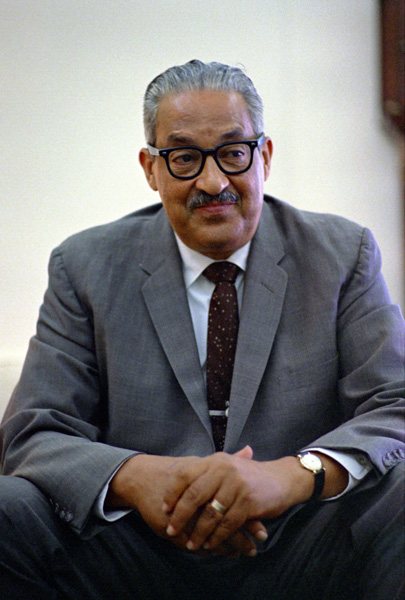
A Baltimore beginning
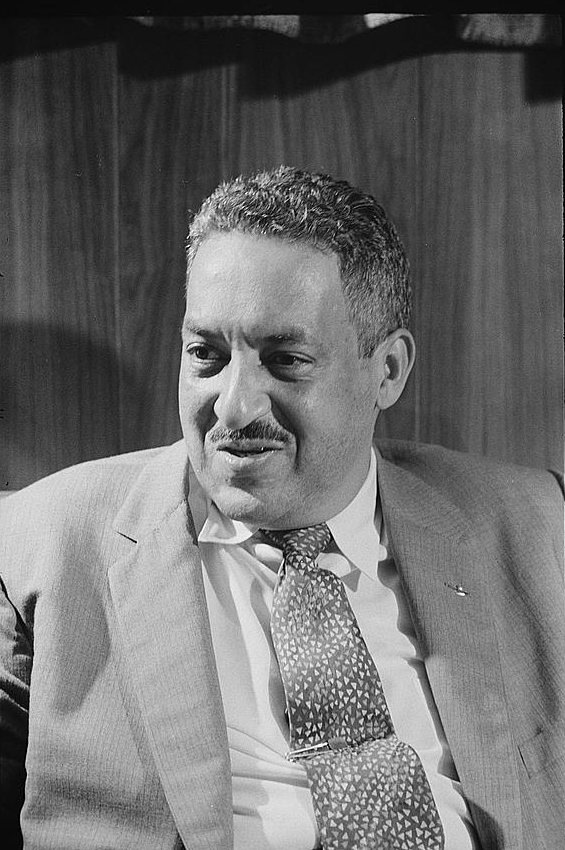
Thurgood Marshall was born in Baltimore on July 2, 1908. His father, William Marshall, worked as a railroad porter and later at a whites-only country club. His mother, Norma, was a schoolteacher. He attended Frederick Douglass High School and graduated from Lincoln University in Pennsylvania in 1930.
The University of Maryland’s law school, in his own state, did not admit Black students. Marshall went instead to Howard University School of Law in Washington, D.C. There he met his mentor, Charles Hamilton Houston, who was training a generation of Black lawyers to challenge segregation in court. In 1933 Marshall graduated first in his class.
Taking segregation to court
Marshall opened a law office in Baltimore and began working for the city’s NAACP branch. In 1935 he and Houston represented Donald Gaines Murray, who had been refused admission to the University of Maryland’s law school because of his race. A Baltimore judge ordered the school to admit him, and on January 15, 1936, Maryland’s highest court affirmed the ruling. Murray graduated in 1938.
Marshall joined the NAACP’s national legal staff in 1936. In 1940 he founded the NAACP Legal Defense and Educational Fund and served as its director-counsel until 1961. Case by case, he wore down the doctrine of “separate but equal.” In Smith v. Allwright (1944), brought by Lonnie Smith, a Houston dentist, the Supreme Court struck down Texas’s whites-only Democratic primary. In Shelley v. Kraemer (1948) it ruled that courts could not enforce agreements barring Black families from buying or renting homes. In Sweatt v. Painter (1950) it ordered the University of Texas to admit Heman Sweatt to its law school. Over his career Marshall argued 32 cases before the Supreme Court and won 29.
While the Union survived the Civil War, the Constitution did not. In its place arose a new, more promising basis for justice and equality, the fourteenth amendment, ensuring protection of the life, liberty, and property of all persons against deprivations without due process, and guaranteeing equal protection of the laws.
Brown v. Board of Education
Marshall led the legal team that challenged segregated public schools. He argued Brown v. Board of Education before the Supreme Court in 1952, and again in 1953. On May 17, 1954, the Court ruled unanimously that segregated public schools were unconstitutional, overturning the “separate but equal” rule of Plessy v. Ferguson.
The decision did not end the fight. In 1957 Marshall went to Little Rock, Arkansas, with attorney Wiley Branton and won a federal court order that let the nine Black students known as the Little Rock Nine return to Central High School under federal protection. In 1958, in Cooper v. Aaron, the Supreme Court ruled unanimously that the Little Rock school board could not delay integration.
The first Black justice
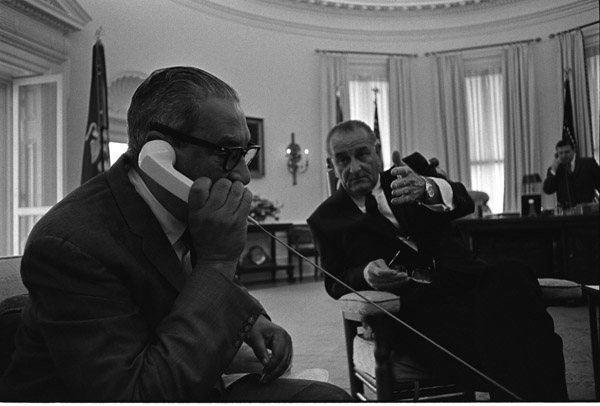
In 1961 President John F. Kennedy appointed Marshall to the U.S. Court of Appeals for the Second Circuit. Southern senators delayed his confirmation until September 1962. In 1965 President Lyndon B. Johnson named him Solicitor General, the government’s lawyer before the Supreme Court. He was then the highest-ranking African American official in the federal government.
On June 13, 1967, Johnson nominated Marshall to the Supreme Court. The Senate confirmed him on August 30 by a vote of 69 to 11, and on October 2, 1967, Chief Justice Earl Warren swore him in as the Court’s 96th justice and its first African American member. He served for 24 years. He opposed the death penalty in every case, and with Justice William J. Brennan Jr. he dissented again and again when the Court upheld death sentences. In a 1987 speech marking the Constitution’s bicentennial, he said the framers’ government had been “defective from the start.”
Marshall left the Court in 1991 because of failing health. He died of heart failure on January 24, 1993, in Bethesda, Maryland, at the age of 84. He is buried at Arlington National Cemetery.