Taken onto free soil
Dred Scott was born into slavery in Southampton County, Virginia, around 1799. He was held by the family of Peter Blow, who brought him to St. Louis in 1830. Blow died there in 1832.
Around 1833 Scott was sold to Dr. John Emerson, a surgeon in the U.S. Army. Emerson took him to Fort Armstrong at Rock Island, Illinois, a free state. In 1836 Emerson moved to Fort Snelling, in a territory where the Missouri Compromise of 1820 barred slavery. Scott went with him.
At Fort Snelling Scott married Harriet Robinson, a teenager enslaved by Major Lawrence Taliaferro. Emerson bought Harriet. In 1838 their daughter Eliza was born aboard the steamboat Gipsey, north of the line the Missouri Compromise had closed to slavery. A second daughter, Lizzie, was born later in Missouri; records disagree on the year.
In May 1840 the army ordered Emerson to Florida. He left his wife and the Scotts in St. Louis, where the Scotts were hired out to others.
Eleven years in court
Emerson died in Davenport, Iowa, in December 1843, and his widow, Irene Emerson, claimed the Scott family. The Scotts were hired out to work in St. Louis. By March 1846 they were hired to a man named Samuel Russell.
On April 6, 1846, Dred and Harriet Scott filed separate petitions for freedom in the St. Louis Circuit Court. “Dred Scott, a man of color, respectfully states to your honor, that he is claimed as a slave by one Irene Emerson,” his petition began. It set out the years he had spent at Rock Island and Fort Snelling, where slavery was barred. Dred Scott signed it with his mark.
The first trial, in June 1847, failed on a technicality in the testimony, and the judge granted a new trial. At the second trial, on January 12, 1850, a St. Louis jury found the Scotts free. Irene Emerson appealed. On March 22, 1852, the Missouri Supreme Court reversed the verdict by a vote of two to one. “Times now are not as they were, when the former decisions on this subject were made,” the court said.
On November 2, 1853, Scott brought a new suit for trespass in the U.S. Circuit Court in St. Louis. The defendant was John F. A. Sanford, Irene Emerson’s brother; the case records spell his name Sandford. In May 1854 a federal jury found that the Scotts were still enslaved.
They had for more than a century before been regarded as beings of an inferior order, and altogether unfit to associate with the white race, either in social or political relations; and so far inferior, that they had no rights which the white man was bound to respect…
The decision
The U.S. Supreme Court heard the case in February 1856 and again that December. On March 6, 1857, Chief Justice Roger B. Taney read the opinion of the Court. Seven of the nine justices ruled against Scott.
Taney held that Black Americans were not citizens of the United States and could not sue in its courts. He also held that Congress had no power to ban slavery in the territories, and that the Missouri Compromise was unconstitutional. The case went back to the lower court with orders to dismiss it.
The ruling sharpened the national conflict over slavery. The National Archives judges that it moved the country closer to civil war.
Freedom, and after
The Court left the Scotts enslaved. After the ruling, ownership of the family passed to Taylor Blow of St. Louis, whose family had first brought Dred Scott to the city. On May 26, 1857, Blow formally freed the Scott family in a St. Louis court.
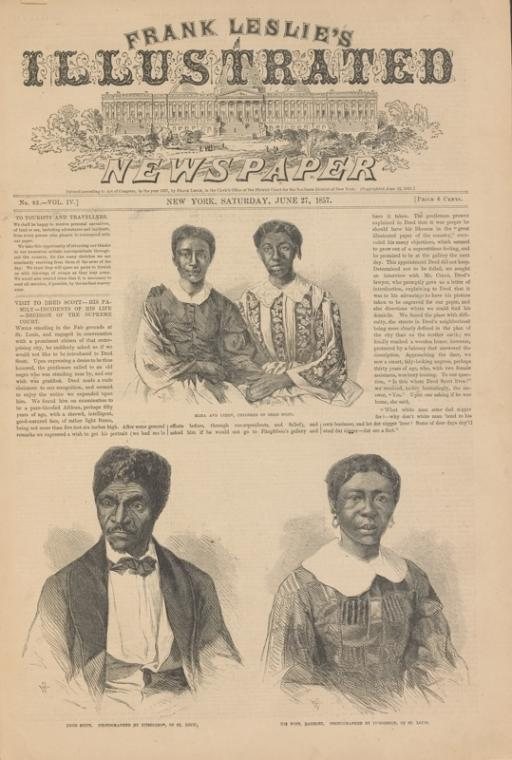
Soon afterward a reporter for Frank Leslie’s Illustrated Newspaper visited the family. On June 27 its front page carried engraved portraits of all four Scotts, made from photographs by John H. Fitzgibbon of St. Louis.
Dred Scott lived as a free man for about sixteen months. He died of tuberculosis in St. Louis on September 17, 1858, and was buried in the city’s Wesleyan Cemetery. In 1867 Taylor Blow had his remains moved to Calvary Cemetery. Harriet Scott died on June 17, 1876, at the home of their daughter Lizzie and her husband, Wilson Madison. Their descendants still live in St. Louis.
After the Civil War, the Thirteenth and Fourteenth Amendments overturned the decision that bears his name.